SHI 12.24.25 – A Toast, and goodbye, to 2025
December 24, 2025SHI 01.21.26 — “Take the Hit”
January 21, 2026
A deadpan comic once quipped, “It’s a small world … but I wouldn’t want to paint it.”
Indeed. Another line from Stephen Wright I enjoy: “I intend to live forever. So far, so good.” Spot on, Steve. Good luck with that.
And with this thought in mind, that most “ends” are somewhat inevitable, I begin my first blog post of 2026.
“
What happens when growth ends?”
Growth is the primary foundational concept of modern economics. In this modern era, especially within capitalist systems, economies are expected to continuously expand. Earnings growth expectations supports a strong stock market. GDP growth expectations underpin improving quality of life. A growing jobs market supports labor force expansion. And an expanding population, in turn, helps promote growth in earnings, GDP and the labor force.
Growth and expansion are key in modern society and economics. Think of the game “musical chairs.’
So what happens if expansion stops? What happens when growth ends?
Welcome to this week’s Steak House Index update.
Why You Should Care: The US economy and US dollar are the bedrock of the world’s economy.
But is the US economy expanding or contracting?
Expanding.
The ‘real’ growth rate — the number most often touted in the mainstream media — was 4.3% in the last quarter. That is a HUGE growth rate. In “current dollar” terms, US annual economic output rose to $31.095 trillion.
According to the World Bank, the world’s annual GDP expanded to over $111 trillion in 2024. Further, IMF expects global GDP to reach almost $132 trillion by 2030. The US? Various forecasts project about $37 trillion for American GDP in 2030 — I believe it could be even higher.
America’s GDP remains around 28% of all global GDP. Collectively, the US, the European Common Market, and China generate about 70% of the global economic output. These are the 3 big, global players. They bear close scrutiny.
The objective of this blog is singular.
It attempts to predict the direction of our GDP ahead of official economic releases. Historically, ‘personal consumption expenditures,’ or PCE, has been the largest component of US GDP growth — typically about 2/3 of all GDP growth. In fact, the majority of all GDP increases (or declines) usually results from (increases or decreases in) consumer spending. Consumer spending is clearly a critical financial metric. In all likelihood, the most important financial metric. The Steak House Index focuses right here … on the “consumer spending” metric. I intend the SHI10 is to be predictive, anticipating where the economy is going – not where it’s been.
Taking action: Keep up with this weekly BLOG update. Not only will we cover the SHI and SHI10, but we’ll explore “fun” items of economic importance. Hopefully you find the discussion fun, too.
If the SHI10 index moves appreciably -– either showing massive improvement or significant declines –- indicating growing economic strength or a potential recession, we’ll discuss possible actions at that time.
The Blog:
Economists point out that economic growth is supported by three pillars: Innovation, capital accumulation and human capital. We can see that the first two continue unabated as we survey global economies, but the third pillar appears to be “crumbling.” Said another way, “human capital” cannot grow if populations stall … or decline. Sure, one could argue that in some respects AI might replace “human capital” in some ways; but, ignoring this nuance for the moment, when a developed nation population peaks and begins to decline, the pillar known as “human capital” is definitely crumbling.
Not rapidly, some might argue. Sure, that is true: Shrinking developed nations are, for the most part, shrinking very, very slowly. But while that is true, it overshadows the fact that shrinking developed nation populations are aging rapidly. And these two facts, when taken together, are rapidly eroding the ground underneath our economic foundation.
The best example of this phenomenon is Japan.
In the two years through fiscal 2024, Japan reported over 22,000 sinkholes.
Aging water pipes break. So do sewage pipes, roads, and bridges. This problem is not unique to Japan. Every developed nation has the exact same problems. What is unique to Japan is that many of these known problems are not quickly resolved. In fact, according Bloomberg more than 22,000 bridges flagged for reinforcement between 2019 and 2023 remained untouched as of August of last year.
The town of Suzu is at the tip of the Noto Peninsula on western Japan — the opposite side of the island from Tokyo. This area has been in continuous population decline since the 1950s. The area has lost about half its population after peaking. There is no housing shortage in Suzu, Japan. Quite the opposite: It is common for homes to be listed for $0 — that’s right, nothing. Homes are simply given away if the buyer agrees to renovate or demo it.
The Ukai Bridge is a key crossing. This is what the bridge looks like today:
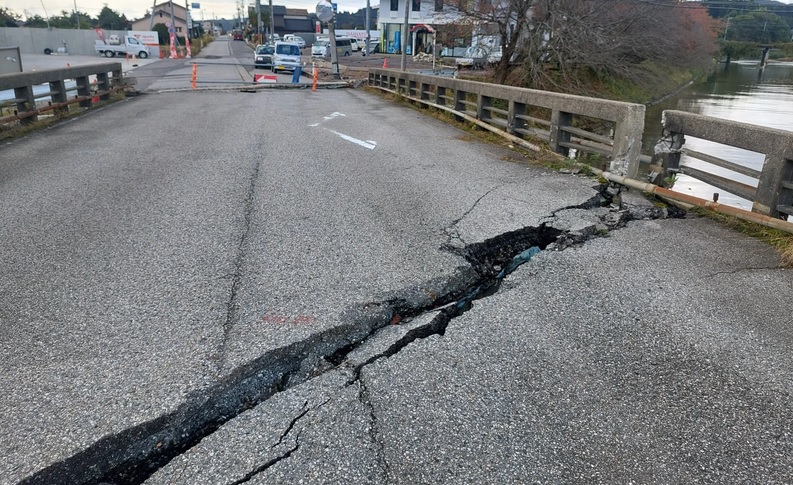
That crack was the result of a sizable earthquake on New Year’s Day in 2024. Two years later, the unpassable bridge remains unpassable. The two-year bridge replacement project has yet to begin.
That developed nation infrastructure decays and collapses with time is a surprise to no one. That many of those repairs and replacements have not even started might be. “Depopulation,” aging, shrinking local and property tax revenues have become common trends across much of rural Japan.
Per Bloomberg: In the past 25 years, Suza municipal tax revenues have dropped 43% as the working-age population declined nearly by half.
The StatisticsTimes reports Japan’s current population at about 122.7 million. Japan is shrinking fairly rapidly. UN-based datasets show Japan losing almost 700,000 people per year, the result of extremely low fertility (1.2) and minimal immigration. According to the UN, Japan is now the fastest-shrinking major country in the world. Analysts believe the country may fall below 100 million citizens as early as 2044. This is a staggering decline for a country who peaked at almost 129 million just 15 years ago. Reports suggest that every “prefecture” (city/area) with the exception Tokyo is shrinking. Even Tokyo is becoming an “older, quieter city” as their population ages.
But even more troubling is the accelerated aging of their society. 50 years ago, Japan had few “older” citizens. But with the passing of 50 years, those young folks become “older.” And with a fertility rate far below replacement, the country has an inadequate number of new “younger” folks. This is a serious problem. The population pyramids below tell the story. On the right, we see that in 1975 Japan’s population pyramid looked like, well, a pyramid.
The 2024 age dispersion is on the left. It’s easy to see the problem. Without strong immigration or lots of new babies, Japan’s population has become top-heavy — there are far more citizens 50+ years of age than younger than 50.
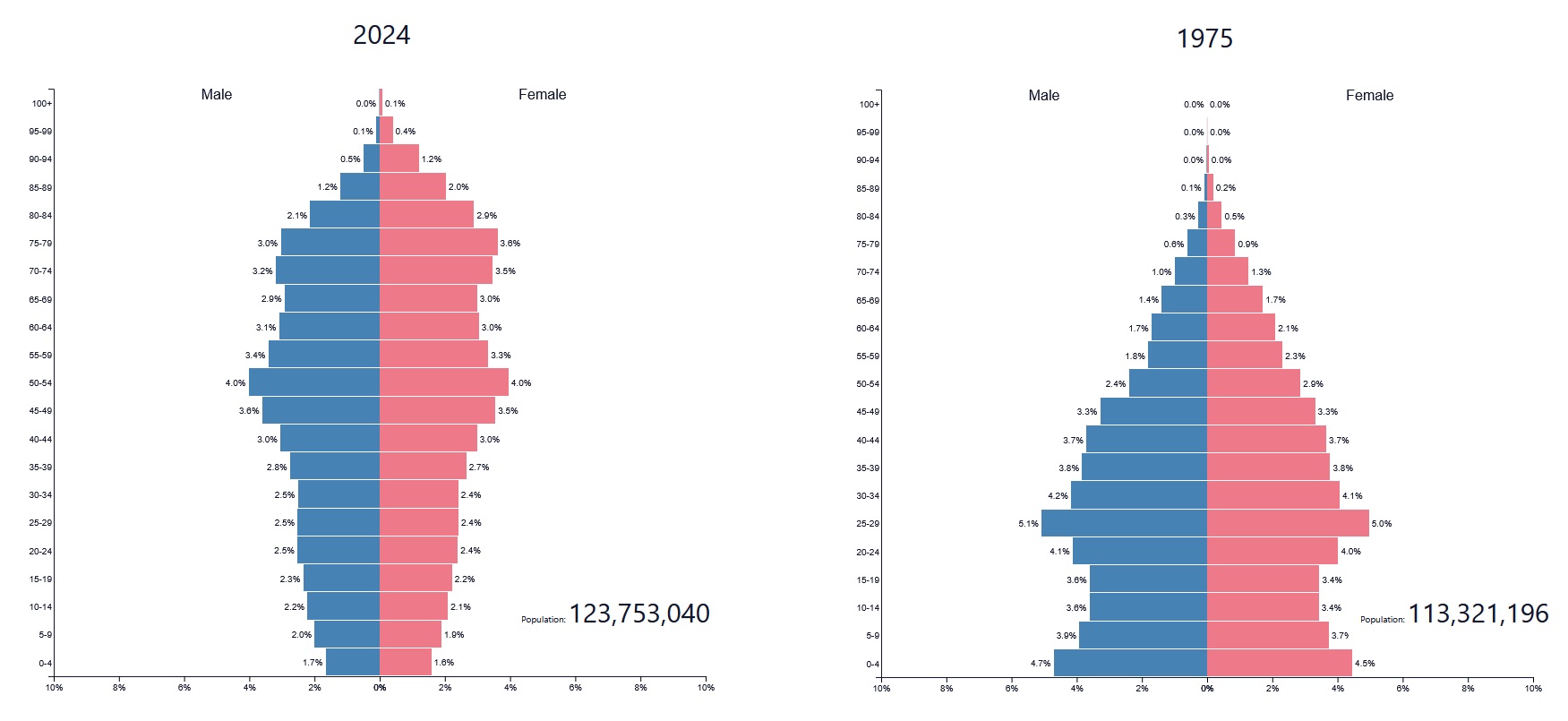
Fast forward to today and we find a Japan with 1 in 3 citizens aged 65+; a nation with only 60% of the population in the “working age”; and, a country with over 1.6 million deaths per year. Today, Japan has the highest “elderly” population share in history.
When growth ends, there are consequences. Pension and healthcare costs explode. The young labor force — which is also not growing — is overwhelmed by the weight of the population relying on their productivity, creating a massive tax burden. Along with the aging and shrinking population, aging infrastructure decays and governments lack adequate tax revenues to adequately repair the damage.
And then we have the damage to consumer spending. Old folks don’t relocate often — so overall home sales rates also decline. But even worse is the inherent value bifurcation: Rural and suburban home values can fall precipitously in these conditions. Only the cities and “prime” real estate hold their value — or possibly increase in value.
Fewer cars and durable (consumer) goods are sold. And the list goes on … and on … and on.
Even the restaurants are impacted. Restaurant revenues in Japan collapsed during Covid — as they did everywhere. But the cheap Yen has helped fuel tourism across Japan. This has helped hold revenues fairly steady. But probably not for long …
The bottom line: When growth ends shrinking begins. Japan’s economic vitality is “flat” at best today. As their labor force shrinks, rural regions collapse, infrastructure ages, consumption shrinks, housing velocity falls, and the tax burdens on the young labor force increase further, the burden on their society will grow exponentially. And Japan is not alone.
South Korea is even worse. Their fertility rate is only 0.72! China, Italy, Greece Portugal, Spain, Germany and “Eastern Europe” are all experiencing a similar problem. In fact, the United Nations latest UNFPA report stated, “The world’s ten fastest shrinking populations are all in Central and Eastern Europe.” Wow.
Today’s blog is an introduction into this juicy topic. Expect more in future blogs, because this is an important discussion.
No, the “danger” is not clear and present. These “shrinking issues” will not overwhelm us tomorrow or even for another decade or more. But like all slow-moving existential human problems, the lack of speed doesn’t make it any less important or any less concerning.
Here’s something to think about: Could AI “solve” a lot of these societal problems? Hmmm …. interesting. 🙂
Well, I don’t know about you, but after all that “bad news”, I could use a large glass of cabernet and a perfectly grilled steak.
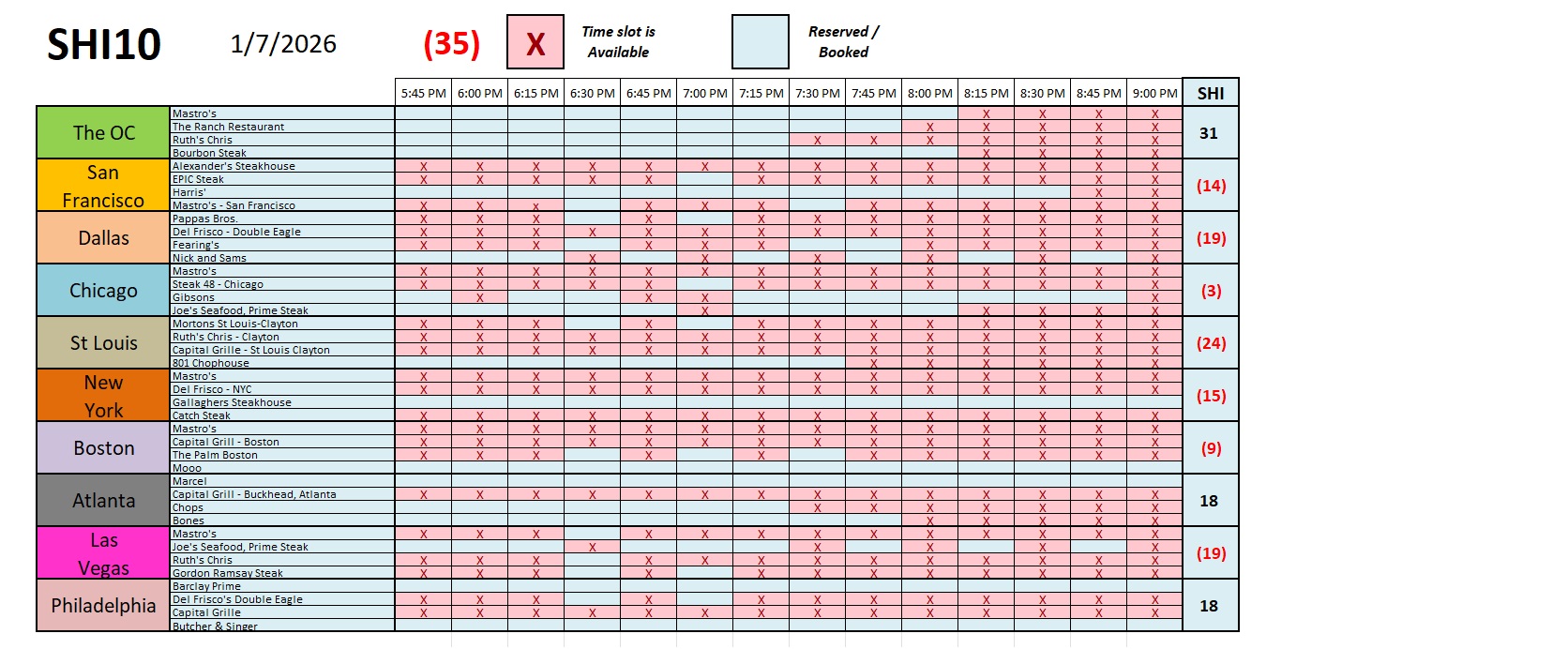
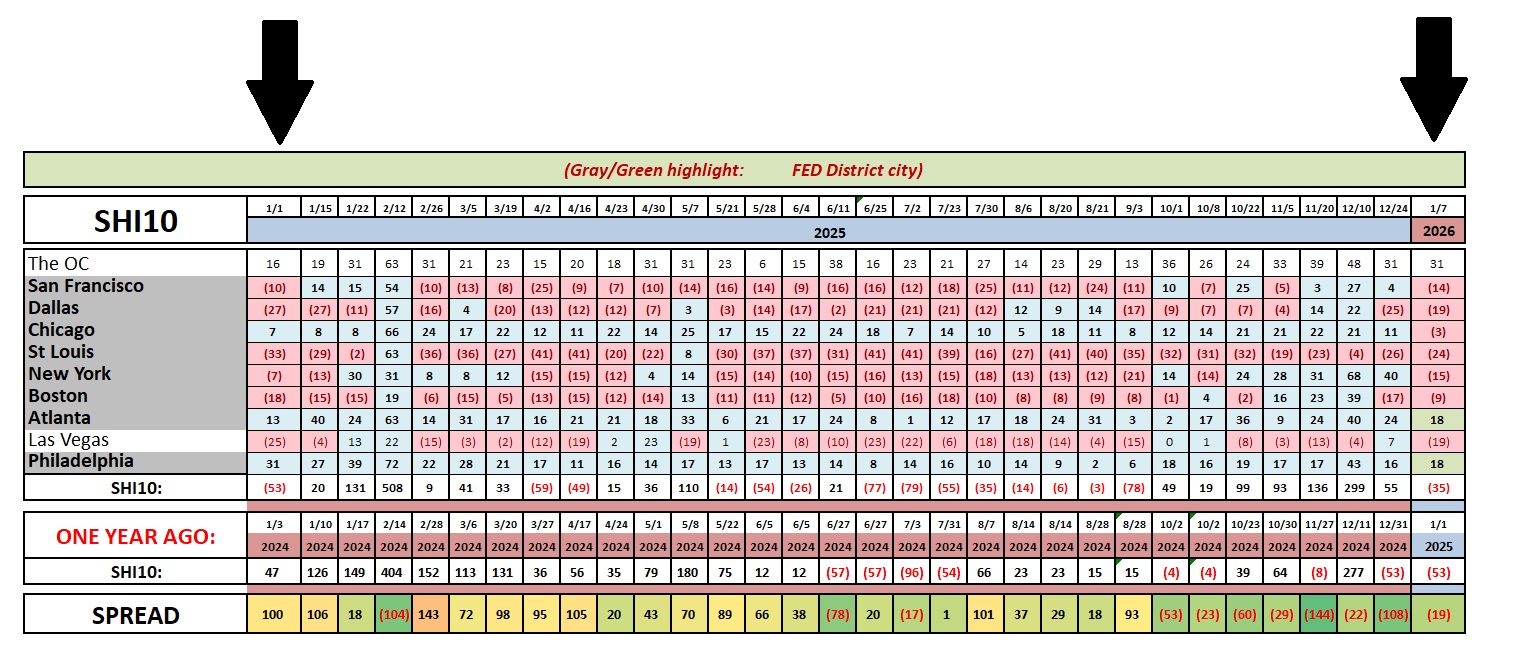
Today’s restaurant reservation tally here in the United States remains robust. In fact, as you can see below (check out the black arrows), demand as 2026 begins is actually a bit stronger than this time last year:
Thanks for tuning in. Happy New Year!
<: Terry Liebman :>