SHI 4.1.26 – A Season For Mischief

SHI 3.24.26 – Unknown Unknowns
March 25, 2026
Today is April 1st.
So you know what that means. Yep. Trust no one. Trust nothing. Consider every utterance, every suggestion, and every promise to be suspect at best … absolutely false at worst. Don’t get caught!
“
Happy ‘April Fools Day!’ “
“
Happy ‘April Fools Day!’ “
Of course, you can trust me! Have no fear, loyal readers, I’ve got your back. 🙂
Welcome to this week’s Steak House Index update.
If you are new to my blog, or you need a refresher on the SHI10, or its objective and methodology, I suggest you open and read the original BLOG: https://www.steakhouseindex.com/move-over-big-mac-index-here-comes-the-steak-house-index/
Why You Should Care: The US economy and US dollar are the bedrock of the world’s economy. But is the US economy expanding or contracting?
Expanding … according the ‘advanced’ reading just released by the BEA, Q4, 2025 GDP grew — in ‘current-dollar‘ terms — at the annual rate of 5.1%.
The ‘real’ growth rate — the number most often touted in the mainstream media — was 1.40%. In current dollar terms, 2025 US annual economic output reached almost $31.50 trillion.
According to the IMF, the world’s annual GDP expanded to over $115 trillion in 2024. Further, IMF expects global GDP to reach almost $135 trillion by 2028 — an increase of more than 28% in just 5 years.
America’s GDP remains around 25% of all global GDP. Collectively, the US, the European Common Market, and China generate about 70% of the global economic output. These are the 3 big, global players. They bear close scrutiny.
The objective of this blog is singular.
It attempts to predict the direction of our GDP ahead of official economic releases. Historically, ‘personal consumption expenditures,’ or PCE, has been the largest component of US GDP growth — typically about 2/3 of all GDP growth. In fact, the majority of all GDP increases (or declines) usually results from (increases or decreases in) consumer spending. Consumer spending is clearly a critical financial metric. In all likelihood, the most important financial metric. The Steak House Index focuses right here … on the “consumer spending” metric. I intend the SHI10 is to be predictive, anticipating where the economy is going – not where it’s been.
Taking action: Keep up with this weekly BLOG update. Not only will we cover the SHI and SHI10, but we’ll explore “fun” items of economic importance. Hopefully you find the discussion fun, too.
If the SHI10 index moves appreciably -– either showing massive improvement or significant declines –- indicating growing economic strength or a potential recession, we’ll discuss possible actions at that time.
The Blog:
As today is the actual ‘April Fools Day’ day, and as the AI chatbots are fabulous at research, I threw this question into chat:
“What is the origin story behind April Fools Day?”
By it’s answer, you would think the chatbot was an economist. Because essentially it answered, “It’s a mystery.” Pretty funny.
But the most popular theory dates back to 1582 when France switched to the ‘Gregorian calendar’ which — unlike the ‘Julian calendar’ instituted by none other than Julius Caesar — start each new year on January 1st.
Before the change, the new year began on April 1st. Of course, like most changes, this one took a long time to gain full adoption and in some countries the new calendar took hundreds of years for January 1st to “stick” as the date the new year began. The French, of course, adopted the new calendar immediately. England procrastinated for almost 200 years, finally formally adopting the Gregorian calendar in 1752. The French and English love to ridicule each other. They have for centuries. So when the English continued to celebrate the new year on April 1st, the French quite enjoyed labeling them fools. And the tag stuck. Mischief did too. So watch out for pranks today. Even here. Maybe.
OK, with that admonition, here we go.
“Fannie Mae to Accept Crypto-Backed Mortgages for the First Time”
That’s right! You can now get a crypto-mortgage! Or can you … fact or fiction? Am I fibbing? Remember … today is April Fools Day!
It’s true. Sort of. FNMA has announced it will soon accept crypto-backed mortgages for the first time. The crypto-exchange ‘Coinbase’ will permit homebuyers to ‘pledge’ their crypto holdings at Coinbase as a downpayment. A 2025 Redfin survey found that about 1/8 of all millennial and Gen Z homebuyers sold crypto to make their down payment … so this apparently is the next step in the mainstreaming of crypto. I’m not a fan, of course, but Fannie Mae didn’t ask me. So sad. 🙁
So that one is true — or will be shortly. How about this one?
“Japanese Homebuilders Increase and Expand Construction Activity”
That one must be fake, right? After all, I covered the shrinking population across Japan in a prior blog and shared how housing prices, in some suburban areas of Japan, are plummeting!
Nope … this one is true as well.
Japanese home builders are expanding their footprint and increasing housing construction. But they’re not doing it in Japan. It turns out they’re doing it here. In the good ol’ US of A. Since 2020, Japanese builders have acquired 23 US based homebuilders. Sumitomo Forestry just announced they are paying $4.5 billion to acquire Tri Pointe Homes based in Nevada.
At first glance, this might seem counter-intuitive. The US housing markets are extremely challenging right now. Homebuilding is lukewarm at best. On an earnings call earlier today, Restoration Hardware reported an earnings miss. Their CEO, Gary Friedman commented the combination of high interest rates, persistent inflation, and low inventory has made the US housing market “the most dire housing market in decades.” That sounds pretty bad.
So what do the Japanese home builders know that we don’t know?
For a centuries-old Japanese builder, the answer is pretty simple: They know they can’t build new homes in Japan. That’s a bad business plan. Thus, even a soft US housing market is a far better alternative to building in Japan. Deeply entrenched demographic and population issues have pushed Japanese builders out of the country for greater opportunity. Welcome to America!
In February, Sumitomo Forestry, a Japanese home builder and timber company, announced the purchase of Tri Pointe Homes, a Nevada-based builder that produces about 5,000 homes a year. Tri Pointe ranks in the top 20 builders in the US. When that deal closes, Sumitomo will become one of the top 5 US homebuilders. They will be just ahead of the 6th largest US Builder, Sekisui House, who purchased MDC Holdings for $4.9 billion.
Sumitomo Forestry traces its origins to a time before the United States was the United States. In 1691 they began managing forests around a Japanese copper mine to supply timber for construction and fuel. Sumitomo is one of the oldest continuously operating “wood-related” enterprises in the world.
Sekisui House is much younger. Founded in 1960 as a subsidiary of a chemical company, Sekisui House saw an opportunity to apply industrial manufacturing methods to Japan’s post-war housing shortage. Their early focus was prefabricated housing. They became a pioneer in modular construction, steel-frame housing, and later zero-energy homes. Do they plan to offer pre-fab homes in the US?
I can give you the answer, but will you trust it? I mean, after all, today IS April Fools day. Consider every statement with suspicion!
Yes, they do. Really. Trust me. In fact, they already have. While they acknowledge US building codes vary significantly across the country, cities and counties, and there are other significant obstacles like unions and entrenched building systems, they built their first fully pre-fab community in Temecula in 2023. And this may surprise you: Current listing prices for their ‘pre-fab’ homes start at $1.67 million.
OK, that one must be false! That must be a prank!
Nope. All true.
Their pre-fab system, called SHAWOOD, is a pre‑engineered structural system manufactured with millimeter‑level precision in a controlled environment. As a result, these homes allow for large spans, open interiors, and energy efficient performance. Unlike other modular systems, however, these homes are assembled on‑site.
Structural parts of the framing are pre-cut and pre-drilled in Japan and then shipped to the US. For their structural skeleton they employ a propriety metal joint system that uses no nails at major joints, using steel connectors that lock beams and columns together — an important feature in both Japan and the US to make the homes extremely rigid and earthquake resistant. Their homes are more “precision-engineered framing” than fully modular homes. Presumably, Sekisui would argue their extremely precise design systems result in a higher quality home, not one less expensive.
Sekisui operates highly automated house-component factories in Japan. These plants are regarded by experts as some of the most advanced in the world, producing components using robotic welding and precise QA systems. These components are then shipped all over the world. According to Sekisui, they have “delivered” more than 2.7 million homes globally.
Why are many Japanese home builders expanding in the US? In a word, survival. Their “home” market is no longer expanding. Quite the opposite — they are shrinking. While they do still build some homes in Japan, they can’t grow there. So they have sought and found greener pastures across the world in places like the US, Australia, New Zealand and Singapore, to name a few.
Darwin’s evolutionary theory of “natural selection” suggests species only survive by adapting to changing environments. Clearly, Japanese home builders are doing just that. Fascinating.
So everything today’s blog today is 100% certified true! 🙂
To the steakhouses!
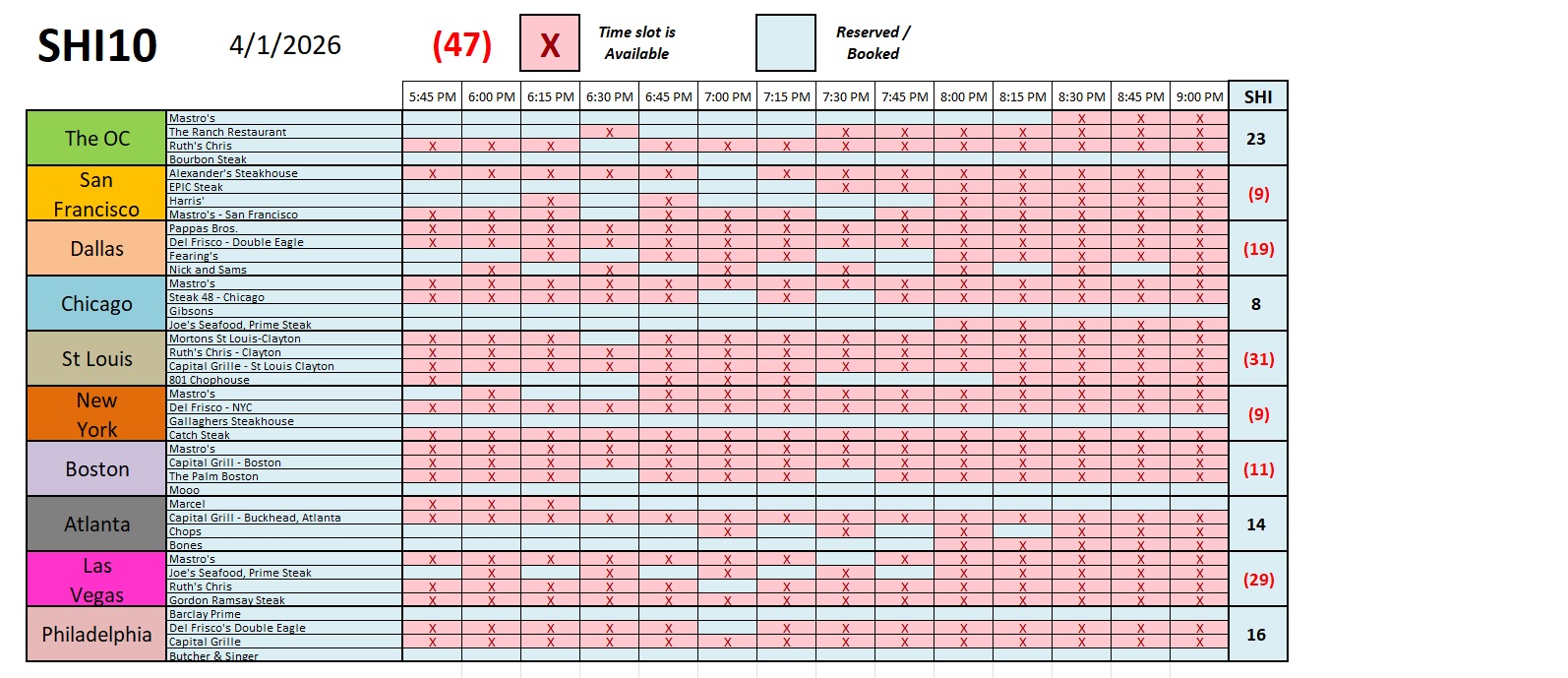
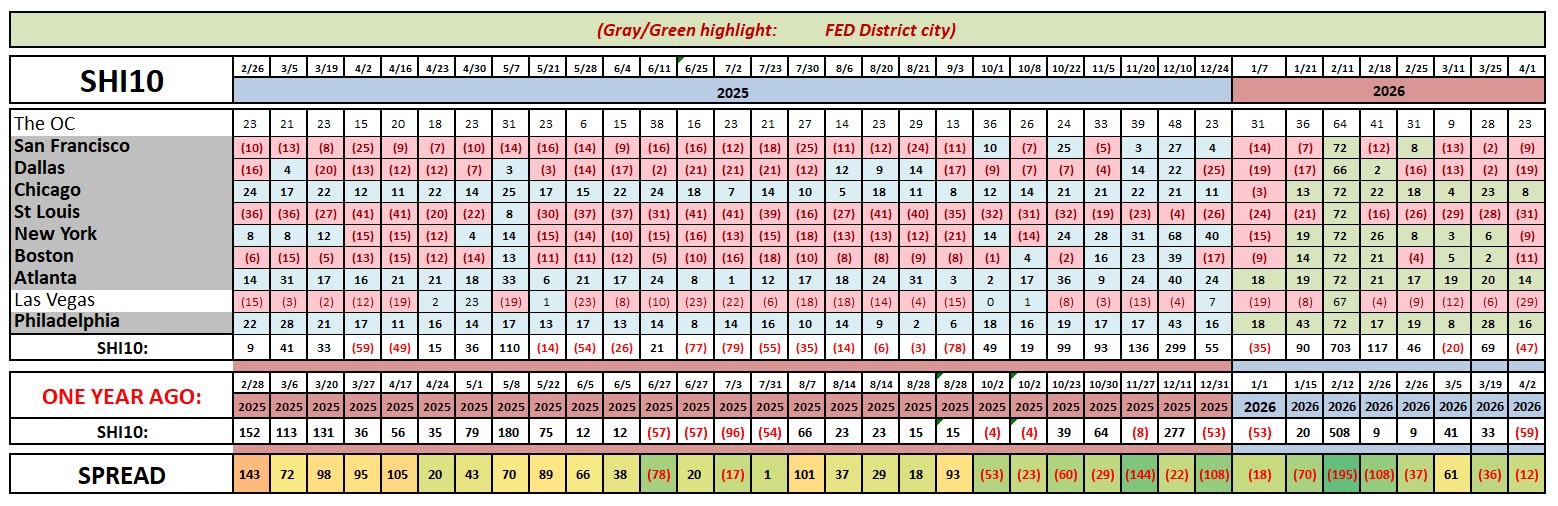
As you can see above and below, reservation demand in our pricey steakhouses is as lukewarm as the Japanese housing market. Well, maybe not quite that bad … but this week’s numbers are pretty weak. Perhaps demand is muted in light of overall economic anxiety, probably exacerbated by the Iran conflict? Quite likely.
Here’s the long term trend chart.