SHI 10.21.26 – The Tipping Point

SHI 10.14.26 – So What’s Normal?
October 14, 2026
Have you read Malcolm Gladwell’s book “The Tipping Point”?
It’s worth a read. I believe it crystalizes thoughts and ideas around how something, some issue or concern, which has been obscure for a long time seemingly overnight goes viral. This pattern is common and repeats often throughout economic history. A current example is unfolding before our eyes.
France has run a fiscal deficit for more than half a century. Their last budget surplus was logged in 1974. For more than 51 years, they have borrowed money to operate the government. For more than 51 years, the bond markets watched, yawned, and paid little attention. Perhaps until now.
The 10-year French sovereign bond is called an OAT. Seemingly all of a sudden the yield on OATs has skyrocketed. Yes, all sovereign yields, all across the globe, are up this year; but the OAT is way up. Has France finally reached the tipping point?
“
French 10-year bond is the OAT.
In Germany, it’s the Bund. “
“
French 10-year bond is the OAT.
In Germany, it’s the Bund. “
Context helps us make sense about facts. France and Germany are two leading economies in the European Union.
Comparing movement in their bond yields over time gives us context. The euro was introduced in 1999. Historically, the spread between the 10-year OAT and the German Bund was below 50 basis points – about ½ a percent. That spread began 2026 slightly elevated at about 60 basis points. Today it is almost 160 basis points. The spread is rising fast.
Another great book, Hemmingway’s “The Sun Also Rises,” has an entertaining take on the topic. In the book, one character asks another, “How did you go bankrupt?” The response: “Two ways. Gradually, then suddenly.” 🙂
Welcome to this week’s Steak House Index update.
If you are new to my blog, or you need a refresher on the SHI10, or its objective and methodology, I suggest you open and read the original BLOG: https://www.steakhouseindex.com/move-over-big-mac-index-here-comes-the-steak-house-index/
Why You Should Care: The US economy and US dollar are the bedrock of the world’s economy. But is the US economy expanding or contracting?
Expanding … according the ‘advanced’ reading just released by the BEA, Q2, 2026 GDP grew — in ‘current-dollar‘ terms — at the annual rate of 8.0%.
The ‘real’ growth rate — the number most often touted in the mainstream media — was 1.50%. In current dollar terms, during Q2 the annual economic output reached almost $32.50 trillion.
According to the IMF, the world’s annual GDP will expand to over $126 trillion in 2026. Of that amount, the US makes up over 25% — expected to reach $32.4 trillion by the end of 2026. Further, IMF expects global GDP to reach almost $135 trillion by 2028 — an increase of more than 28% in just 5 years.
America’s GDP remains around 25% of all global GDP. Just four countries—the United States, China, Germany, and Japan—generate roughly half of all economic activity worldwide. Collectively, the US, the European Common Market, and China generate about 65% of the global economic output. These are the 3 big, global players. They bear close scrutiny.
The objective of this blog is singular.
It attempts to predict the direction of our GDP ahead of official economic releases. Historically, ‘personal consumption expenditures,’ or PCE, has been the largest component of US GDP growth — typically about 2/3 of all GDP growth. In fact, the majority of all GDP increases (or declines) usually results from (increases or decreases in) consumer spending. Consumer spending is clearly a critical financial metric. In all likelihood, the most important financial metric. The Steak House Index focuses right here … on the “consumer spending” metric. I intend the SHI10 is to be predictive, anticipating where the economy is going – not where it’s been.
Taking action: Keep up with this weekly BLOG update. Not only will we cover the SHI and SHI10, but we’ll explore “fun” items of economic importance. Hopefully you find the discussion fun, too.
If the SHI10 index moves appreciably -– either showing massive improvement or significant declines –- indicating growing economic strength or a potential recession, we’ll discuss possible actions at that time.
The Blog:
Is France going bankrupt right now?
Probably not. I seriously doubt it. I suspect they remain in the “gradually” condition. They’ve been here for 51 years.
However, there is reason for increasing concern today. And that concern reflects in relative yields. Each EU member can sell sovereign bonds denominated in euros. Germany and France both access the debt markets this way. Germany’s Bund is yielding 3.42% today. The French OAT is a hair under 5%. That puts today’s spread near 1.6%. Here’s the spread history from January thru September:
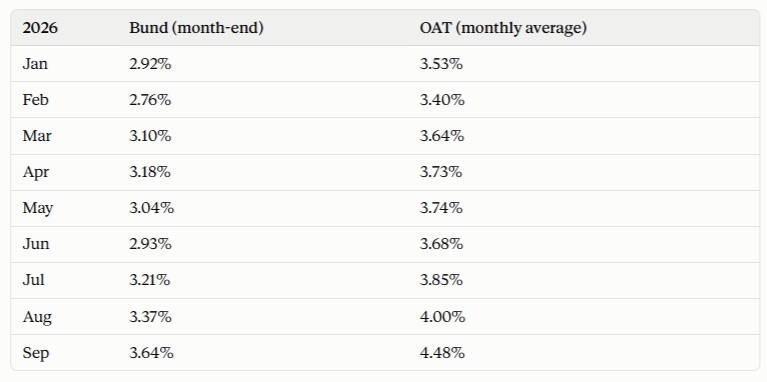
Bankruptcy may be off the table today, but in my opinion the country is clearly struggling. The protests and riots we see in the news are tangible evidence. But no, I don’t think France, the euro, or the European Union are in catastrophic economic trouble.
But France faces serious challenges. We face similar challenges here in the US, of course, and for similar reasons. Like France, we also run a chronic budget deficit. Like France, the US seemingly lacks the political will to solve the problem. I expect the French turmoil will continue for some time.
But I also expect the EU and ECB will step in and defend the French OAT. Because they must. If we imagine the EU as a boat with a small hole where the French sit, the other EU members cannot sit idly by as the boat takes on water. The hole has to be plugged or they all sink when the boat goes down. The EU countries will argue, point fingers, and cast aspersions, but ultimately, they will collectively figure out a way to plug the hole.
According to the Bank for International Settlements, the Euro is the world’s second most important currency. The dollar and the euro form an effective “duopoly” in global finance. No other country or currency is close. Consider these facts:
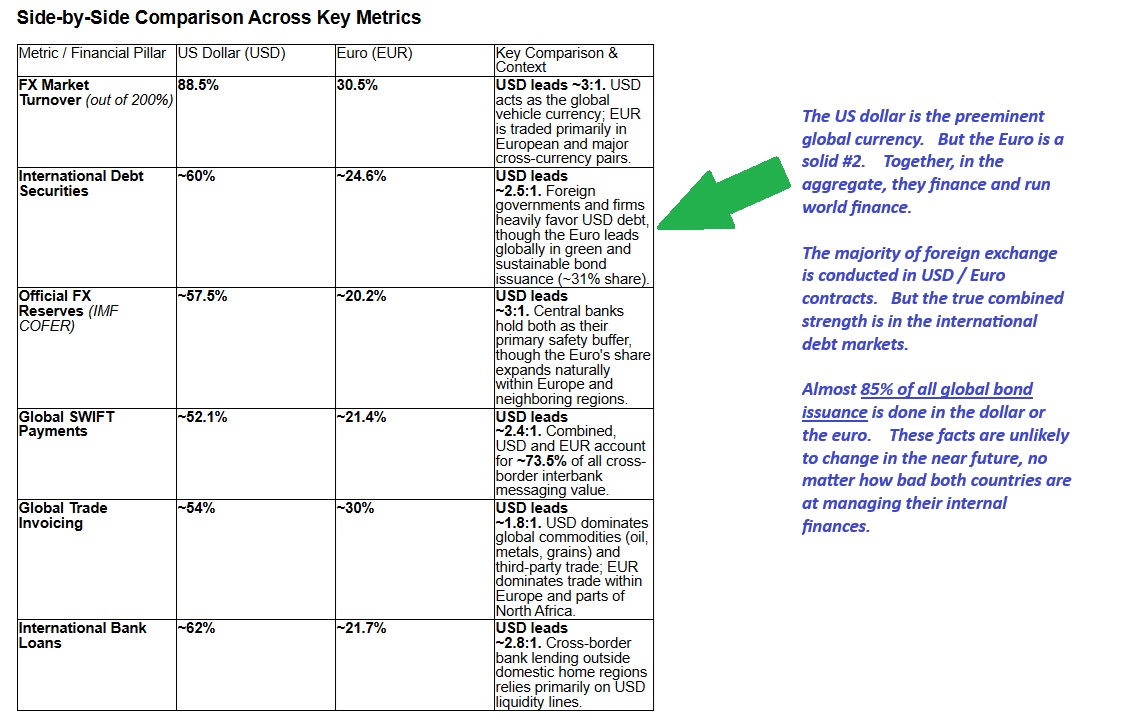
It’s important to note the 85% global bond issuance discussed above is international. Intra-country issuances are excluded. Bonds issued by Japan inside Japan, for example are excluded from this calculation.
Please don’t take my comments above to suggest that the dollar or euro are immune to, or exempt from, failure because of their current hegemony. That would be the wrong take away. Remember, the English Pound was the global reserve currency 100 years ago. Things changed. And things could change here too. It’s hard to imagine a new or different reserve currency … but I’m sure that’s what the English aristocracy was saying about the Pound 100 years ago.
The take away here is this: Yields are up everywhere. Most advanced nations are carrying exceptional levels of debt. But the debt parade doesn’t end there. Even developing nations in Africa like Nigeria, Morocco and Egypt, are carrying exceptional levels of debt today. Those three nations owe, 33%, 66% and 87% as a percentage of GDP, respectively, according to IMF 2026 projections. Remember, however, that for every debtor there is a creditor. Every dollar lent is owed to someone else. So while debt owed is at record levels, so is the income paid to creditors. As Paul Simon famously and metaphorically said, “One man’s ceiling is another man’s floor.” 🙂
To the steakhouses!
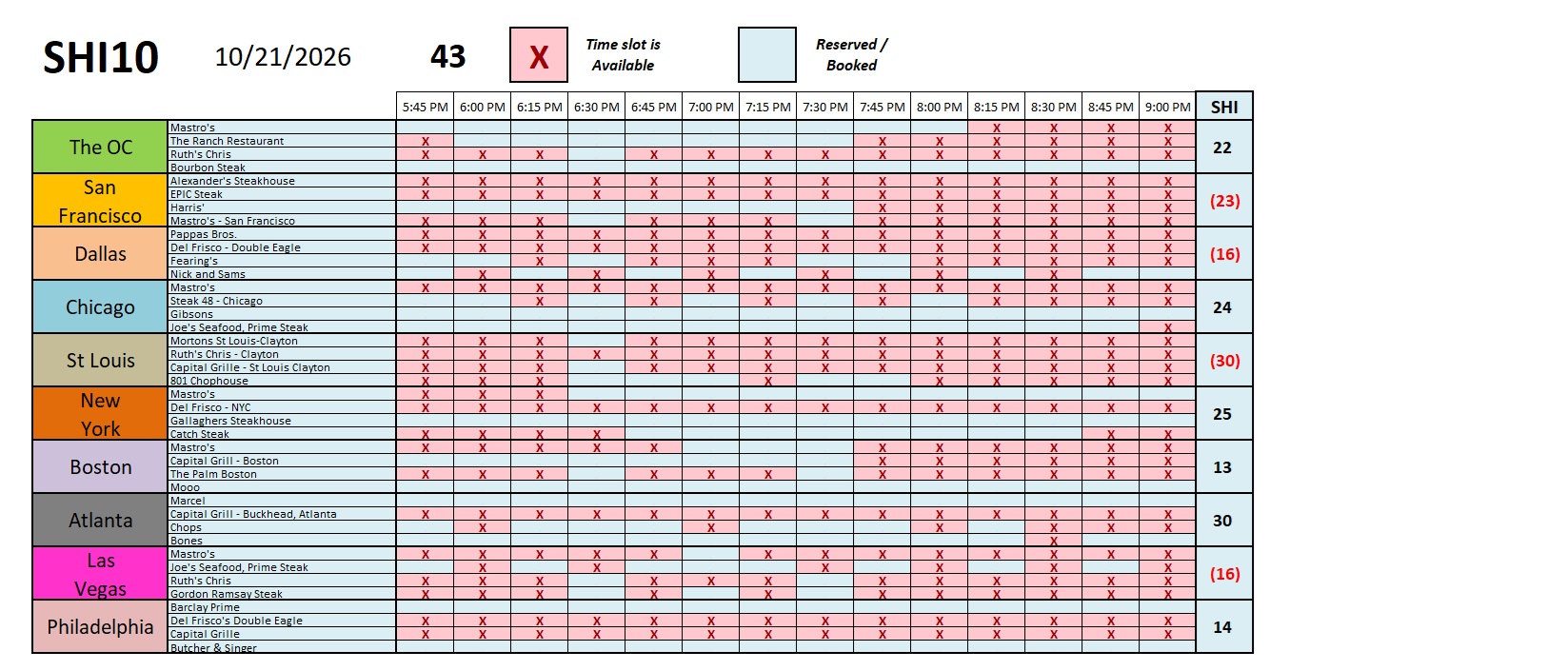
I wish I could same something exciting here, but alas, the SHI10 is almost unchanged week over week.
Reservation demand remains robust, but the number of steaks on the grill is pretty flat. I guess the best thing I can say here, using steak-talk, is this: Today’s SHI reading is a ‘rare‘ example of economic stability for an economy ‘well done.‘
How’s that? 🙂
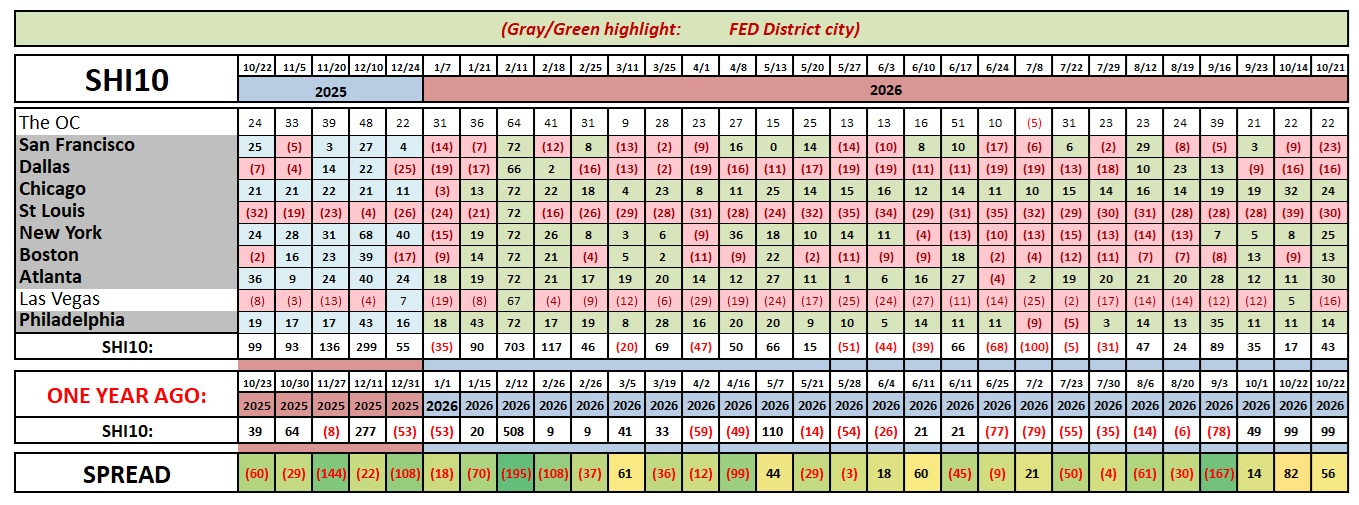
As of today, the Atlanta FEDs ‘GDPNow’ estimate for Q3 GDP growth is 3.50%, a more optimistic forecast than the NY FED which is predicting 2.70%. And this is somewhat interesting:
The Wall Street Journal surveyed 71 economists for their inflation, yield, and GDP expectations. I found their response on GDP expectations to be quite interesting. In general, the panel sharply revised upward their forecast for GDP growth to 3.10% for the third quarter, up from 2.00% in the July survey. Of 64 economists who provided forecasts in both surveys, 60 forecasted higher growth for the quarter. Here’s the chart from the article:
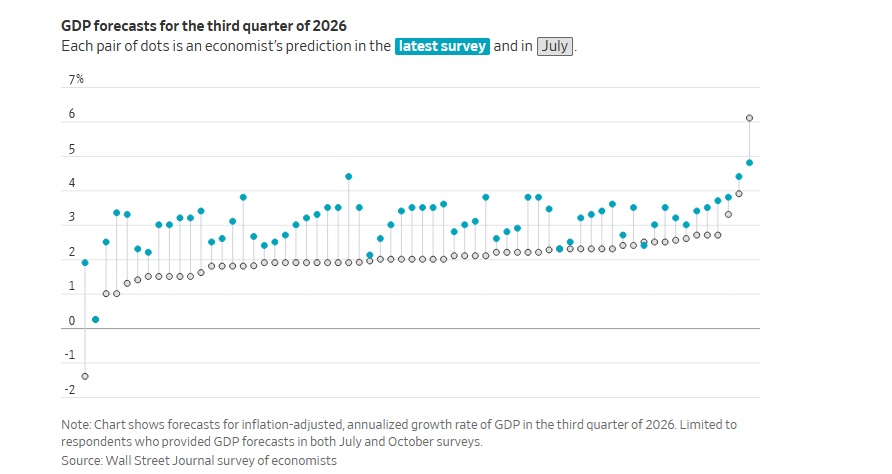
Check out that “dot” on the far right. That economist lowered his/her forecast from over 6% in the prior survey! Wow.
As always, remember these are ‘real’ GDP numbers. Current dollar numbers would be 3% higher. Those are some impressive numbers, folks!
<Terry Liebman>