SHI 11.11.26 – At The Intersection of Economics and Politics

SHI 10.28.26 – Where’s The Beef? (Again)
October 28, 2026
Let me begin today with a hearty ‘Thank You!’ to all our US military, past and present.
Votes are still being counted in the west, but the mid-term election is over and the message from voters is unequivocal. From sea to shining sea, Americans are unhappy.
Of course, American unhappiness was on display months, perhaps years, before the mid-term election. While ‘sentiment’ is not the same as happiness, the University of Michigan ‘Consumer Sentiment’ indexes remain near historic lows. In the most recent, 57% of respondents say that high prices have eroded their standard of living. The FED also does a monthly consumer survey called the “Survey of Consumer Expectations” or SCE. Almost 43% of the respondents in the SCE said they were financial worse off than a year earlier.
“
The problems are real. “
“
The problems are real. “
I suspect French citizens would say the same – or worse. Financial unhappiness feels like a global phenomenon today. But beyond these very real financial concerns, does ideology remain a source of American angst, as it has in past elections? Are Americans feeling an overwhelming sense of anxiety about the future? Or is something else at play here?
Today we’re diving into the deep-end of the pool where economics and politics intersect.
Welcome to this week’s Steak House Index update.
If you are new to my blog, or you need a refresher on the SHI10, or its objective and methodology, I suggest you open and read the original BLOG: https://www.steakhouseindex.com/move-over-big-mac-index-here-comes-the-steak-house-index/
Why You Should Care: The US economy and US dollar are the bedrock of the world’s economy. But is the US economy expanding or contracting?
Expanding … according the ‘advanced’ reading just released by the BEA, Q2, 2026 GDP grew — in ‘current-dollar‘ terms — at the annual rate of 8.0%.
The ‘real’ growth rate — the number most often touted in the mainstream media — was 1.50%. In current dollar terms, during Q2 the annual economic output reached almost $32.50 trillion.
According to the IMF, the world’s annual GDP will expand to over $126 trillion in 2026. Of that amount, the US makes up over 25% — expected to reach $32.4 trillion by the end of 2026. Further, IMF expects global GDP to reach almost $135 trillion by 2028 — an increase of more than 28% in just 5 years.
America’s GDP remains around 25% of all global GDP. Just four countries—the United States, China, Germany, and Japan—generate roughly half of all economic activity worldwide. Collectively, the US, the European Common Market, and China generate about 65% of the global economic output. These are the 3 big, global players. They bear close scrutiny.
The objective of this blog is singular.
It attempts to predict the direction of our GDP ahead of official economic releases. Historically, ‘personal consumption expenditures,’ or PCE, has been the largest component of US GDP growth — typically about 2/3 of all GDP growth. In fact, the majority of all GDP increases (or declines) usually results from (increases or decreases in) consumer spending. Consumer spending is clearly a critical financial metric. In all likelihood, the most important financial metric. The Steak House Index focuses right here … on the “consumer spending” metric. I intend the SHI10 is to be predictive, anticipating where the economy is going – not where it’s been.
Taking action: Keep up with this weekly BLOG update. Not only will we cover the SHI and SHI10, but we’ll explore “fun” items of economic importance. Hopefully you find the discussion fun, too.
If the SHI10 index moves appreciably -– either showing massive improvement or significant declines –- indicating growing economic strength or a potential recession, we’ll discuss possible actions at that time.
The Blog:
I’ve mentioned this fabulous quote before.
In 1992, James Carville, Bill Clinton’s presidential campaign strategist, uttered these words. It held true then. And it holds true now.
“It’s the economy, stupid,”
American financial angst was fairly obvious months before this latest election tsunami. It’s been clear to me for some time now that Americans have been very unhappy about the Iran War (and the price of gas at the pump), the tariff impact on consumer goods, and data centers for some time now. And that anger has been building month after month.
Paraphrasing Carville, in my opinion, the anger is not ideological. It’s economic. Political pundits suggest the “Blue Wave” has an ideological foundation. I disagree. I believe many voters said, loudly and emphatically, that the American economy is not working for them. The message from the consumers surveys has been consistent; the election results are simply the proverbial cherry on top.
The election results ring loud: America’s leadership was out of touch with the deep, fundamental economic issues across the country. Leadership in this case is both government and corporate. Yes, local, state and federal leadership was impugned. But by extension, where capitalist economics and politics intersect, citizens are yelling loudly to the large corporate boards of directors: Your choices and actions are making our lifestyles too expensive and our lives less enjoyable. You are insensitive. You are failing.
Case in point: Consider AI and the data center boom.
No one wants a data center next door to their house. They are noisy. People report that 500 feet away, you will hear a continuous mechanical hum. And I mean continuous – the cooling equipment operates 24/7. Others say that at 1,000 feet away, the sound is akin to a small drone. Even ½ mile away larger facilities can still be heard. Especially at night when ambient noise fades. Noise pollution is a major complaint about the data centers in Northern Virginia. Local residents complain about non-stop noise from a nearby Amazon data center with 400 rooftop cooling fans. Ouch.
No one wants to listen to perpetual humming or breathe diesel exhaust. But this isn’t the only “quality of life” problem neighbors of data centers face today. Transmission lines are unsightly. The neighborhood “look” is adversely impacted by a giant industrial project next door. Finally, moving on to the economic, consider the impact on utility costs. Across the state, Virgina’s electricity bills are up over 11% in the past year. The same is true in Ohio and Pennsylvania. Sources suggest Iowa is up between 5- 10% In each of these states, the cost for electricity is running about 10% more than a year ago.
Should we blame data centers for this? To some extent, yes. They have contributed to the energy cost increases felt by local citizens. The data center explosion in Texas has not yet triggered a cost increase, but the citizens are clearly worried it will soon. This was a major Texas campaign issue.
In each of these states I mention above, the governor is now a Democrat: Ohio, Iowa and Texas “flipped” in this election. Further, as I write this blog, at least 14 US states have considered legislation to impose a moratorium on new data centers. In fact, a ‘yes’ vote failed in 6 of them, but they teed-up the issue nonetheless. It’s no surprise Virginia has put “approval restrictions” for data centers in place thru July of 2028.
Some might find this state reaction out of sync with their feelings about AI. After all, without data centers we don’t have AI. And everyone loves using AI, right? 🙂
Maybe not everyone … but AI is pretty popular world wide. Microsoft hired Gallup to conduct an extensive poll. It will ultimately cover 140 countries across the globe. Quoting from the report, “Positive feelings about artificial intelligence outweigh negative ones in 34 of the first 37 countries to complete fieldwork this year in Gallup’s ongoing research with Microsoft.”
Interesting. The study measures “public engagement with AI” and asked people to comment on their awareness and use of AI. Here’s the chart:
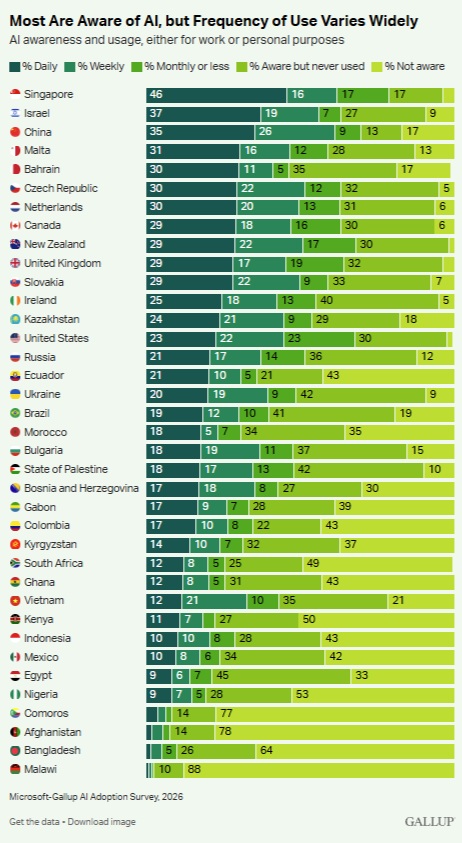
Here we see there are many countries where AI daily usage is far higher than in the US. In fact, 13 countries claim daily use higher than here. Interesting. For a link to the report, click HERE.
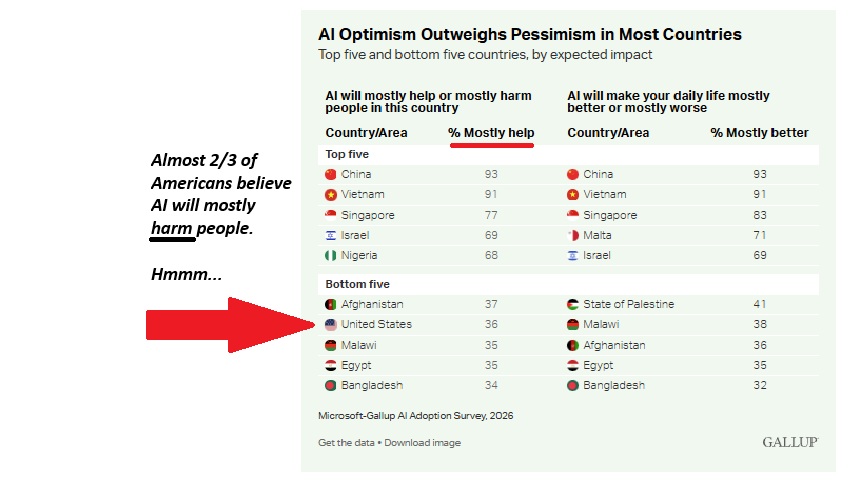
AI optimists generally outnumber pessimists. The poll respondents are super positive about AI in China: 93% saying AI will mostly help their country. AI perception is the US is a polar opposite: Only 36% of American feel AI will benefit people in the US. Does that mean about 64% feel AI will harm citizens? Probably not … but that 64% doesn’t believe it will benefit people. Hmmm …. Here’s the chart.
Perhaps this outcome should be no surprise with a co-founder of Anthropic predicted that AI could eliminate about half of all entry-level white collar jobs within 1-5 years. Yes, he actually said this in an interview back in May of 2025. One has to wonder what he was thinking when he made that prediction.
Toward the end of the poll, Gallup asked its respondents if they were “worried about AI.” Apparently in this metric, the United States was #1! We are the most worried population in the world. The poll shows that 74% of AI-aware adults saying AI makes them feel worried. Makes sense, right? If you live near data centers, your cost of living is higher, your quality of life is lower, and in general your job is at risk!
Anyway, circling back, it’s no surprise that Americans are clearly unhappy with data centers. After all, beyond all the problems they create, they are the manifestation of AI. Frankly, we really can’t blame folks, right?
For years, the American behemoth corporations building the majority of the projects – whether the hyperscalers, the “neoclouds,” or others – have been insensitive to the local citizens. Even worse, they clearly lacked imagination and anticipation. Today’s conditions on the ground suggest they made a (rounds to) zero effort to anticipate obvious future problems, whether perception or financial, years before they arose.
Electricity, for example. It doesn’t take a genius to figure that plugging a massive data center into an existing electric grid, already at capacity, would triggering increased demand and cost to all who rely on that grid. Why didn’t the leaders of these trillion-dollar public companies anticipate this outcome and solve it years before they dug the first foundation ditch? All they had to do was unequivocally guarantee that no citizen’s electricity bill would increase. I’ll leave the mechanics aside for now. But this would have been an intelligent guarantee, and an inexpensive choice for a hyperscaler planning to spend $200 billion a year on new data centers.
But no. Apparently they didn’t consider it. Or if they did, they didn’t proactively implement policies to deal with the issue. Dumb, dumb, dumb. Neither, apparently, did the local governments. Or state governments. Or federal. You get my point.
The groundswell backlash grew as they ignored all local utility issues and resultant noise pollution. And now they are paying the price. Americans don’t want data centers nearby. Americans simply don’t trust them.
On November 4, 2026, SpaceX presented its case to locals to build a 747-acre AI data center about 80 miles east of Tucson. At completion, the facility would have 9 buildings and produce 6 gigawatts of “compute.” That is a huge project. Two SpaceX representatives pitched the project. In that pitch, they outlined substantial economic benefits for the community. Consider the assurances they made:
|-Electricity bills-| SpaceX expected up to 40% reduction for local customers.
|-Property taxes-| About a 20% reduction for existing homeowners.
|-Permanent employment-| Approximately 1,000 new permanent jobs.
|-Electrical Grid-| SpaceX would make $3.6 billion in infrastructure improvements.
|-County tax revenue-| Substantial one-time and recurring tax receipts.
|-Water consumption-| Dry cooling. No groundwater pumped for industrial cooling.
The one-time tax revenues are likely to be enormous: They projected a one-time sales tax benefit of approximately $250 million and additional sales tax revenue of $35 million to $103 million for the local residents and county, although those values are subjective and forecasts.
One might surmise significantly lower property taxes and electricity bills might move the needle towards a thumbs up. But even with these exceptional assurances and the sizable financial windfalls, resistance remains among locals.
It’s clear to me that the US data center industry now has big obstacles to overcome as we roll into 2027 and beyond. Which is a serious economic problem for the US. Let me explain.
Tech industry researchers, credit-rating agencies, and Wall Street equity analysts, collectively, expect about one trillion dollars will be spent on CapEx in 2027. Goldman Sachs projects more: about $1.2 trillion. Morgan Stanley is around there too. Moody’s, a bond rating service, expects closer to the $1 trillion mark. The source for these forecasts is the companies themselves, generally from public filings and comments.
But there’s a fly in the ointment, so to speak. How do these companies spend all that money if no one will permit new construction? Data center construction moratoriums are no longer just a threat. They are very real. If a state passes a state-wide moratorium on new grading permits, building permits, utility hook-ups, etc. – you get the idea – spending a trillion dollars will be hard to do. Construction is facing a hard stop. In the US.
The top-10 companies, by market cap, in the US have a market value of over $26 trillion. They all operate internationally in more than 100 countries. They all use data centers. Big MAMA –Amazon, Microsoft, Google and Meta — all build them. These 4 companies spent $376 billion in 2025 on AI infrastructure. The 2026 spend estimate is about $730 billion. And in 2027, they are expected to spend the vast majority of that $1 trillion we discussed above.
Big MAMA is just 4 companies. And they plan to spend $1 trillion in 2027. Staggering. So we have a big battle brewing. In one corner, many US states seem to be saying, “NO! You will not build those monstrosities here!” In the other corner, we have Big MAMA who plans to spend $1 trillion.
I am confident Big MAMA will build data centers. They will still spend the trillion dollars on AI infrastructure in 2027. And probably again in 2028. Except it might be outside the US if state moratoriums become insurmountable.
Each of these 4 companies have an international data center presence already. Microsoft has more than 70 international “regions” in operation today. Amazon, 39. Google, 43. These companies are not strangers to international law and construction. They are adept at navigating international issues.
One of the best lines I’ve heard in a movie lately was from “The Social Reckoning,” Aaron Sorking’s film about Meta (Facebook) released a month or so ago. A Facebook executive, when being interviewed by the Wall Street Journal, claims Facebook is twice as large as the world’s largest country (number of users) and isn’t afraid of the US Congress, and then comments,
“We’re post-government around here.”
Post-government. Wow. Yes, of course, this film is a work of fiction. But you get my point.
I’m running long here, so I’ll finish today with this very high-level economic summary: I completely understand the American anger. It is fully justified. The SpaceX presentation validated the historic problems and made an attempt to ameliorate them. Perhaps they did. I’ll leave this battle to the municipalities and Big MAMA.
But I really hope they find a solution because it will be very, very bad for America if data center development moves overseas. Economically speaking. Not only will we lose the GDP growth associated with the current construction, this would push trillions of dollars of GDP and wealth creation over seas. Away from the US.
I’ll end here. Next week, I’ll quantify that statement. You will be shocked by the numbers.
To the steakhouses!
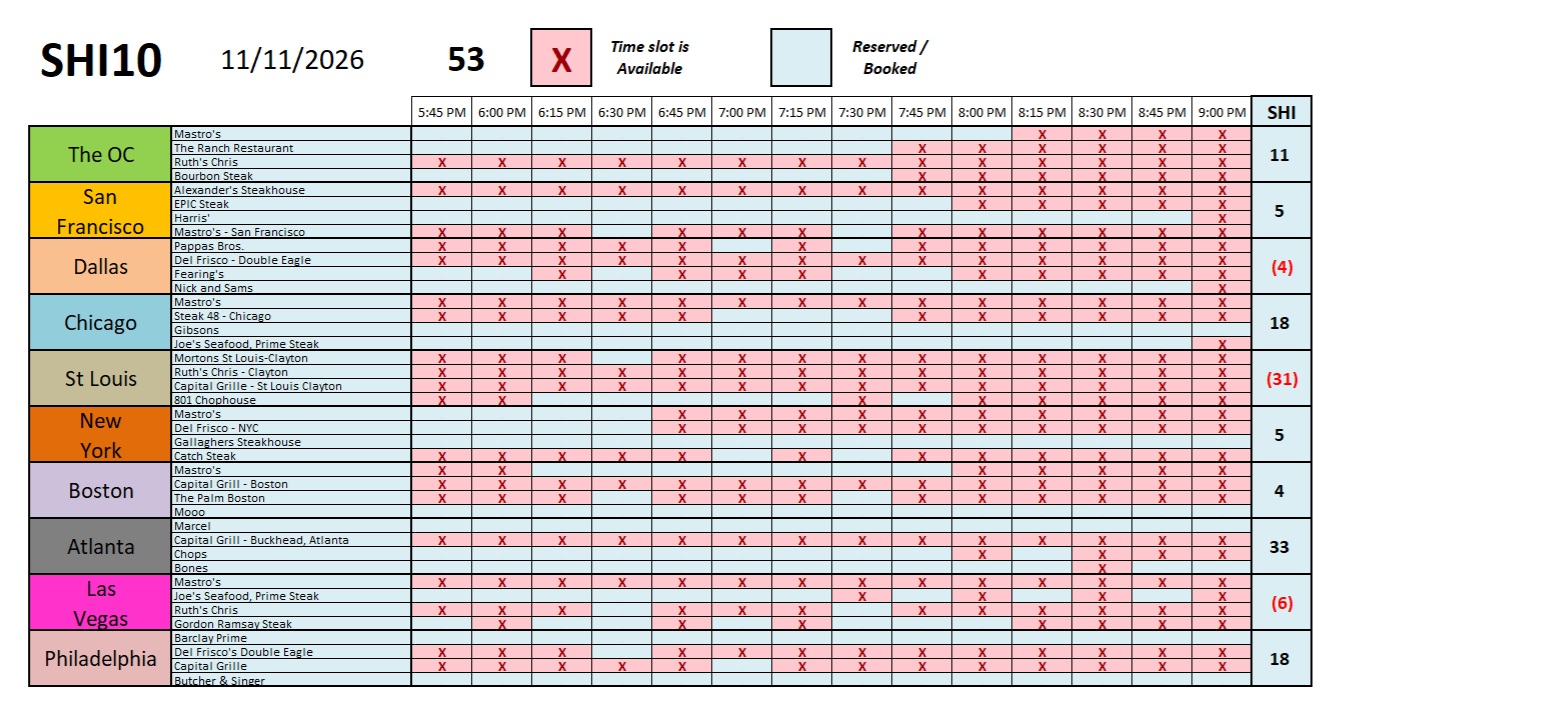
As I expected, reservation demand recovered across the board this week. Once again, we’re back to the consistency of prior weeks.
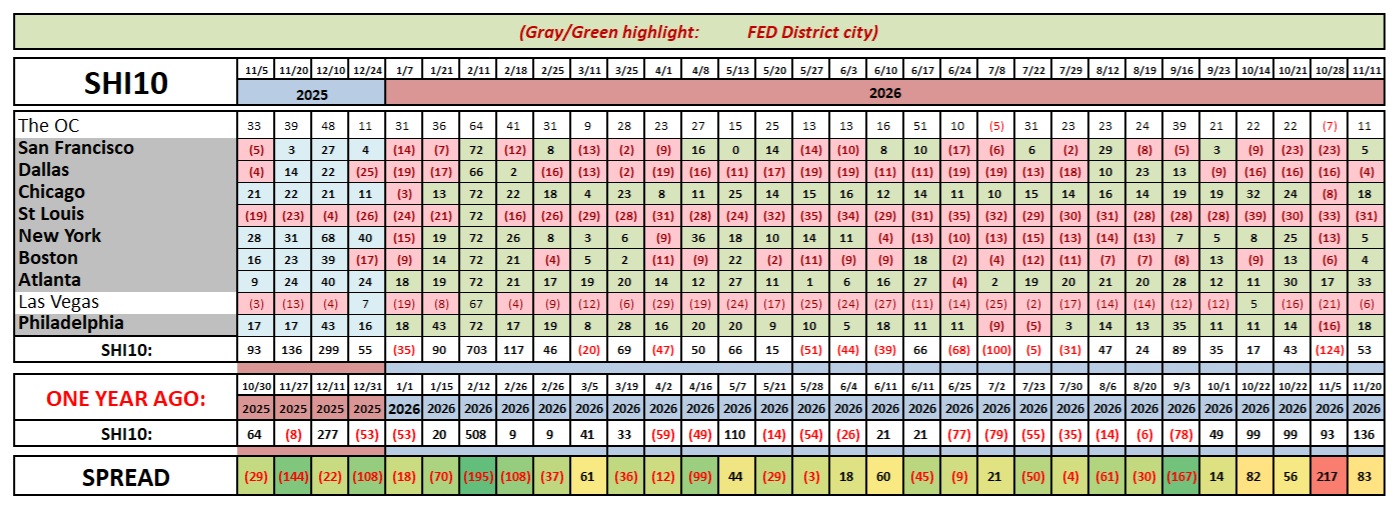
But bad news, folks. The Wall Street Journal tells us that “high beef prices are here to stay.” Ouch.
In a November 9th article, the WSJ tells us there is a cattle shortage.
Quoting the article:
“The shortage is costing meatpackers billions of dollars in losses because the packers can’t fully pass on their higher costs to supermarkets and restaurants. That means more closures, a vicious cycle that leaves the meat industry less prepared for the day when cattle herds eventually expand. Beef prices have become the poster child for food inflation. Everyone is divided on how to fix it. All sides worry that record-high prices for rib-eye and meatloaf will drive consumers away and sap demand.”
Well, that’s not good. But at least we can’t blame the data centers for this one. 🙂
<Terry Liebman>