SHI 5.20.26 – Steaks Don’t Lie

SHI 5/13/2026 – AI or Die
May 13, 2026
SHI 5.27.26 – GENIUS or Dumb?
May 27, 2026
The above image was created by the new ChatGPT 2.0 Image Generator.
I asked the program to create “A photorealistic steakhouse dining room in Manhattan during a rainstorm, viewed from the bar, with warm amber lighting, a Bloomberg terminal in the background, and a subtle satirical ‘Steakhouse Index’ newspaper on the counter.” This was the result. Actually, the original image was a bit fuller, a bit larger. The “header” in this program trims it. So I’ve pasted the entire image down in the body of the blog.
“
Steaks don’t lie!“
“
Steaks don’t lie!“
Steaks don’t lie. Funny. Actually, as you’ll see below, the entire quote from the image is, “Because markets lie, steak doesn’t.” Indeed. 🙂
Welcome to this week’s Steak House Index update.
If you are new to my blog, or you need a refresher on the SHI10, or its objective and methodology, I suggest you open and read the original BLOG: https://www.steakhouseindex.com/move-over-big-mac-index-here-comes-the-steak-house-index/
Why You Should Care: The US economy and US dollar are the bedrock of the world’s economy. But is the US economy expanding or contracting?
Expanding … according the ‘advanced’ reading just released by the BEA, Q4, 2025 GDP grew — in ‘current-dollar‘ terms — at the annual rate of 5.1%.
The ‘real’ growth rate — the number most often touted in the mainstream media — was 1.40%. In current dollar terms, 2025 US annual economic output reached almost $31.50 trillion.
According to the IMF, the world’s annual GDP expanded to over $115 trillion in 2024. Further, IMF expects global GDP to reach almost $135 trillion by 2028 — an increase of more than 28% in just 5 years.
America’s GDP remains around 25% of all global GDP. Collectively, the US, the European Common Market, and China generate about 70% of the global economic output. These are the 3 big, global players. They bear close scrutiny.
The objective of this blog is singular.
It attempts to predict the direction of our GDP ahead of official economic releases. Historically, ‘personal consumption expenditures,’ or PCE, has been the largest component of US GDP growth — typically about 2/3 of all GDP growth. In fact, the majority of all GDP increases (or declines) usually results from (increases or decreases in) consumer spending. Consumer spending is clearly a critical financial metric. In all likelihood, the most important financial metric. The Steak House Index focuses right here … on the “consumer spending” metric. I intend the SHI10 is to be predictive, anticipating where the economy is going – not where it’s been.
Taking action: Keep up with this weekly BLOG update. Not only will we cover the SHI and SHI10, but we’ll explore “fun” items of economic importance. Hopefully you find the discussion fun, too.
If the SHI10 index moves appreciably -– either showing massive improvement or significant declines –- indicating growing economic strength or a potential recession, we’ll discuss possible actions at that time.
The Blog:
Yes, we will be talking about AI yet AGAIN today, but just briefly.
To me, the image below is mind-blowing. From my prompt, G created this thing in about a dozen seconds. Amazing.
Take a look: We see it’s a rainy night, light reflects off the streets. Bloomberg on the TV screen. Inside the steakhouse, we see white table cloths and red leather seats. And a smooth granite bar, with beautiful ambient and reflecting lights. And, of course the old fashioned STEAKHOUSE INDEX newspaper, with the headline “Prime cuts, prime cost.”
Fabulous.

To be clear, while the image is amazing — as is the image generator in this latest version of OpenAI’s 2.0 generator — there’s not much “value” created here. At least not for me. Sure, the image is super cool … but beyond that, there is no true utility here.
But the disruptive capacity of this new program — and the future AI programs in development now — is clear. Imagine you are an illustrator just graduating from art school? Should this image worry you? It would worry me if I were a newly minted college grad. In my opinion, this also holds true for any profession that either directly or tangentially uses “art.” Think advertisers, Hollywood production houses, animators, and the list goes on and on.
Unsurprisingly, US businesses are downright optimistic the disruption will prove beneficial for their bottom lines.
The Federal Reserve Bank of San Francisco just published an article titled
Is Optimism for Artificial Intelligence Boosting Investment?
It’s a worthwhile piece. If you want to read the entire thing, click HERE
The short answer is yes. Optimism is growing like a weed. Here’s a graph I ‘cut’ from the article (with a green arrow added):
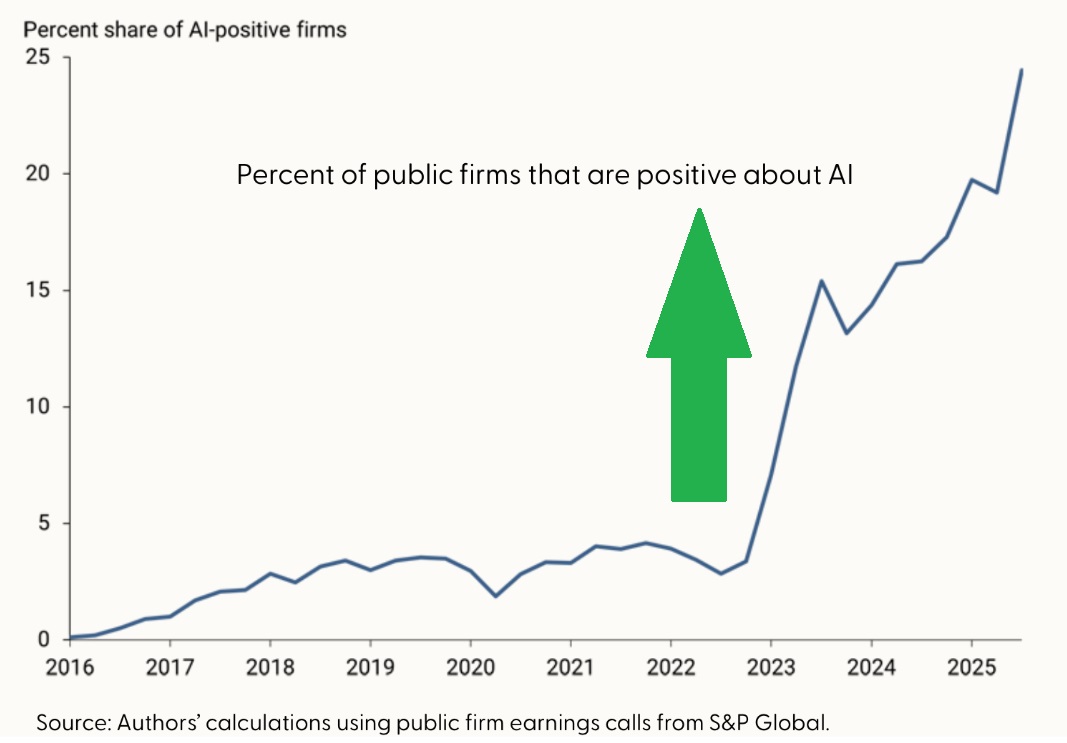
The optimism from public companies, as reported in their earnings calls, was easy to spot: Spending on information processing equipment, software, and data center construction accounted for one-third of all business investment in the third quarter of 2025, according to the latest data from the Bureau of Economic Analysis (BEA) at the time of writing. This was the highest share of total investment since 1947.
It’s also telling that almost all the spending is from the big guys: “The largest AI-positive firms contributed 10 percentage points of the 11% growth of physical capital investment in 2025 from all AI-positive firms. Similarly for R&D, the largest AI-positive firms contributed 7 percentage points out of the 8% growth in 2025.” While the optimism among the largest firms is clear, if measured by “putting your money where your mouth is” smaller companies don’t seem to be participating.
It’s an interesting dichotomy: Is this happening because they are choosing to sit on the sidelines, or are they sitting on the sidelines because the price of entry into building or owning their own AI data center world is simply too high? I think the answer is the latter. I think smaller firms are sitting out the Capex construction boom with an plan and expectation that they will “lease” the capacity later. Instead of buying the “compute”, they plan to lease it.
As positive as US businesses are about this development, however, graduating seniors from 4-year universities are not.
According to a report from ‘Insider Higher Ed,’ students are feeling fearful and unprepared for this rapidly changing new world. “Booing AI” has become a viral trend at many of the 2026 commencement addresses across the country. Google it. Or even better, more keeping with the theme, “AI it.” Many graduates “blame” their university for failing to prepare them for the real world. 55% of those surveyed say their degree programs did not prepare them to use developing AI tools at work. Among GenZ grads specifically, 61% feel unprepared for the AI fueled workplace.
Olivia Malone, a 2026 grad from the University of Arizona, said it this way when asked about her commencement speaker, Eric Schmidt, the former CEO of Google: “His speech was incredibly disrespectful to students. We as students are discouraged from using it and penalized for using it. And then to have our speaker be the champion of AI is just like, OK? Why? Ouch.
Job anxiety looms large. And rightfully so. Data from the Bureau of Labor Statistics — in both their employment and the JOLT reports — support the difficult these graduates face today.
The JOLTS report released a couple weeks ago did show net job growth of about 200,000 folks for the prior month. But the hiring was more churn than growth. It was “replacement hiring.” Here’s what I mean: For every 28 people hired in March, 27 people left their jobs (either voluntarily or via layoff). This is “churn” not growth. Essentially, these companies were back-filling vacated positions rather than filling a new position.
This observation is playing out in the general employment numbers, too. For context, as you look at the chart below, courtesy of the NY Fed (using BLS data), keep in mind that the official current unemployment rate — across all segments of the labor force — is 4.3%.
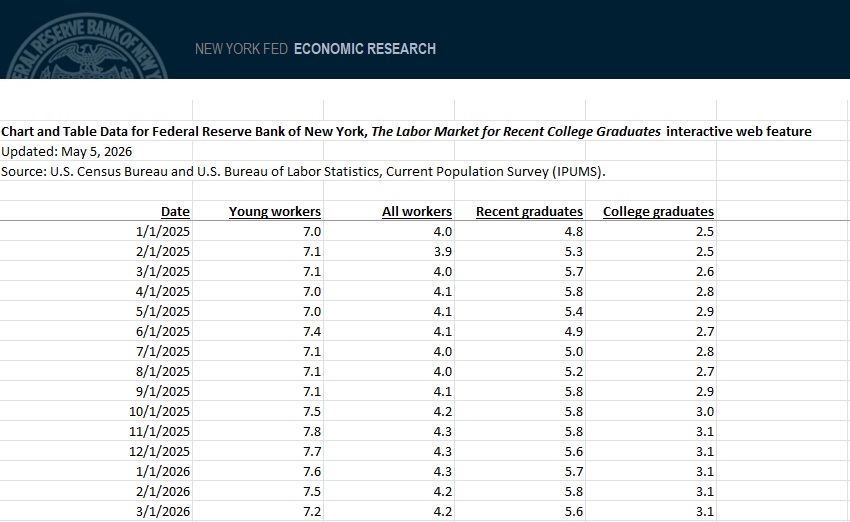
Unemployment amongst “recent graduates” is elevated far above that 4.3% number. In fact, at 5.6% as shown above, in percentage terms, unemployment for recent college graduates is 30% higher than the overall marketplace!
Historically, we typically only see this kind of divergence in the early stages of a recession. And yet, when measured by both real and nominal GDP growth terms, the US economy is booming.
So what’s going on? As I said above, we seem to be in a “replacement hiring” phase. The employment market doesn’t seem to be “growing” many new jobs. Replacement hiring typically has a preference for experienced workers, not recent college grads. If a company is experiencing churn, losing a mid-level analyst, today they prefer to replace that person with an experienced mid-level analyst to avoid the productivity loss. They are less likely to take a chance on a “green” graduate who needs six months of training.
Can we blame AI for this development in the labor markets?
It’s an important question, but I don’t think anyone can answer yet. Of course, the college grads booing the ex-CEO of Google would answer with a resounding “YES!” I suspect some of those companies professing an ever increasing love for all things AI in their public earnings calls might agree, but I suspect most would not.
But here’s something we all agree on: Steaks never lie. 🙂
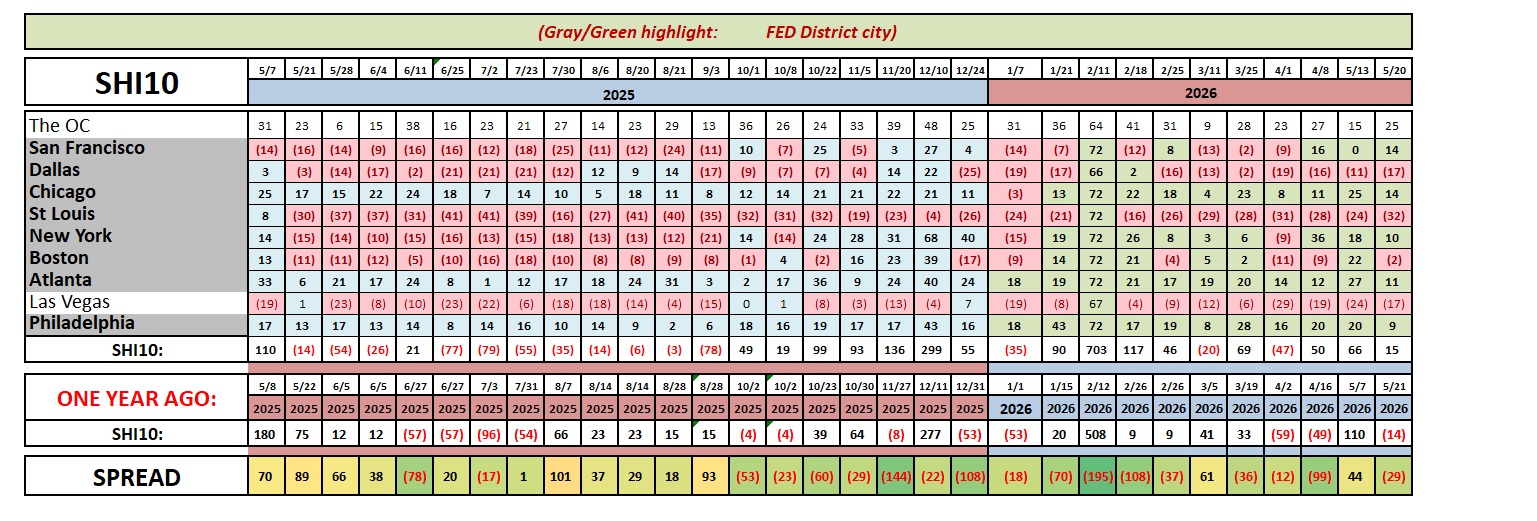
I wish I had some exciting steak house news for you, but, alas, it’s pretty much steady as she goes. Reservation demand, across all 40-SHI restaurants remains fairly consistent week over week. Today’s SHI40 compares favorably to the reading about one year ago.
Back to the employment situation for a few final comments.
I definitely “hear” the college grads who are likely struggling to find a good job after graduation. I suspect most of these young people took on a large armful of debt to cover the cost of their education. Sure, no one promised a good job was waiting for them, but for decades that has been the case. Quite possibly, until now. Is AI changing the paradigm? Does a college education no longer equate to job security? Again, quite possibly. This is a troubling development, but its too soon to decide it is a trend.
Quoting myself, the economic lens requires our vigilance to separate the “important” from the “systemic.” No doubt, this is an important developing story. But I’m not yet sure it is systemic. Time will tell if the crop of college grads for 2026 and years beyond become modern-day Luddites, railing against a systemic change that they feel broke another societal promise.
In the mean time, enjoy that steak and a nice Cab. Because steaks don’t lie.