SHI 7.22.26 – Artificial Distortions

SHI 07.08.26 – To Infinity and Beyond!
July 9, 2026
SHI 7.29.26 — Fun with Numbers!
July 29, 2026
Lately, it feels like all I talk about is AI. To me, AI feels like a veil draped over the world.
In no time, it has quickly and quietly attached itself to almost everything around us.
So today, for a change, we’re not going to talk about AI. After all, this is supposed to be an economic blog! There’s no AI in the word “economy,” right?
Well, actually, there is. The letters may not be there, but AI is. Whether we like it or not, AI is already deeply embedded in the US economy. We would struggle to find an American industry or corporate quarterly earnings release that doesn’t mention AI.
Consider this: In the fourth quarter of 2022, only about 10 to 15% of S&P companies mentioned AI in their earnings calls. Just 3 years later, in Q4 2025 earnings reports, more than 80% mentioned AI.
“
AI is everywhere.“
“
AI is everywhere.“
But there is definitely no ‘AI’ in ‘ROI’. 🙂
I jest. Of course there is. The hyperscalers are working hard to find it right now. But other segments of the US economy seems to be finding ROI, in varying degrees, as they continue to integrate AI into their operations. And nowhere is this outcome more apparent than in the recent quarterly financial results of the G-SIBs. What is a G-SIB you ask? Read on.
Welcome to this week’s Steak House Index update.
If you are new to my blog, or you need a refresher on the SHI10, or its objective and methodology, I suggest you open and read the original BLOG: https://www.steakhouseindex.com/move-over-big-mac-index-here-comes-the-steak-house-index/
Why You Should Care: The US economy and US dollar are the bedrock of the world’s economy. But is the US economy expanding or contracting?
Expanding … according the ‘advanced’ reading just released by the BEA, Q4, 2025 GDP grew — in ‘current-dollar‘ terms — at the annual rate of 5.1%.
The ‘real’ growth rate — the number most often touted in the mainstream media — was 1.40%. In current dollar terms, 2025 US annual economic output reached almost $31.50 trillion.
According to the IMF, the world’s annual GDP will expand to over $126 trillion in 2026. Of that amount, the US makes up over 25% — expected to reach $32.4 trillion by the end of 2026. Further, IMF expects global GDP to reach almost $135 trillion by 2028 — an increase of more than 28% in just 5 years.
America’s GDP remains around 25% of all global GDP. Just four countries—the United States, China, Germany, and Japan—generate roughly half of all economic activity worldwide. Collectively, the US, the European Common Market, and China generate about 65% of the global economic output. These are the 3 big, global players. They bear close scrutiny.
The objective of this blog is singular.
It attempts to predict the direction of our GDP ahead of official economic releases. Historically, ‘personal consumption expenditures,’ or PCE, has been the largest component of US GDP growth — typically about 2/3 of all GDP growth. In fact, the majority of all GDP increases (or declines) usually results from (increases or decreases in) consumer spending. Consumer spending is clearly a critical financial metric. In all likelihood, the most important financial metric. The Steak House Index focuses right here … on the “consumer spending” metric. I intend the SHI10 is to be predictive, anticipating where the economy is going – not where it’s been.
Taking action: Keep up with this weekly BLOG update. Not only will we cover the SHI and SHI10, but we’ll explore “fun” items of economic importance. Hopefully you find the discussion fun, too.
If the SHI10 index moves appreciably -– either showing massive improvement or significant declines –- indicating growing economic strength or a potential recession, we’ll discuss possible actions at that time.
The Blog:
I titled this blog ‘Artificial Distortions’ because the US economy has clearly been distorted by AI.
Of course, those distortions are both good and bad, depending on one’s perspective. But it would be impossible to argue that AI has had little or no impact on or in the US economy. Once glaring example of these distortions is in the earnings at the G-SIBs – the ‘Global Systemically Important Banks.’ This group includes JPMorgan, Citibank, Bank of America and Wells Fargo, to name a few.
Consider the comment from Jamie Dimon from the JPMorgan Q2 2026 earnings call about a week ago. Asked by an analyst “Is this as good as it gets?” Dimon replied, “It’s getting close to as good as it gets. We just don’t know how long it’s going to last.”
As good as it gets? Wow. And he wasn’t kidding. Their Q2 earnings were UP about 27% from one year ago. And they generated a quarterly net income of $21.2 billion. Wow again. That’s a single calendar quarter. Amazing.
These operating results, from the biggest US bank, are super impressive. And you can find the fingerprints of AI just about everywhere in the earnings comments. AI is clearly distorting the quarterly financial results at JPM — in a very, very good way!
CEO Jamie Dimon has been surprisingly candid about this fact. For example, Dimon said the bank is employing fewer people today.
During the earnings call, he explicitly stated AI has already reduced staffing requirements by 30–40% in certain parts of JPMorgan. I’m certain his choice of the word “already” was not a fluke. His message was not, “We’ve realized some one-time productivity gains.” No, it was clear to me: The process has begun. In the call, Dimon said things like, “Every single job will be affected” … and AI is currently “the tip of the iceberg.”
JPM is a global company with about 300,000 employees. It wouldn’t surprise me if their employee count fell by 25% in the next 5 or so years.
The operating changes don’t end there. By their own comments, JPM has one of the largest enterprise AI deployments in the world. They now talk about nearly “1,000 AI use cases” across the company. Dimon added that roughly 50 are particularly meaningful from an economic standpoint. “Economically meaningful” likely means that AI is (1) saving tens of millions of dollars in annual OpEx, (2) finding new revenue sources, (3) reducing losses from fraud, (4) improving regulatory compliance, all, of course, in addition to the headcount reductions discussed above. By any measure, these are exceptionally impressive results. Simultaneously increasing income while simultaneously reducing operating expenses is truly the holy grail for all commercial enterprises.
When talking about big companies, Walmart is about as non-tech as you can get. Yet even Walmart has commented on operational improvements from AI adoption and implementation. They have been able to reduce delivery costs, improve fulfillment efficiency, and improve conversion rates. Unlike JPMorgan, Walmart has not made any headcount comments, but the CEO did comment “AI is going to change literally every job.”
Here’s your take-away: Thus far, we’ve only seen the proverbial tip-of-the-iceberg from AI adoption. You’ve probably been saying the same thing to yourself lately – but I’m confident that it’s true. Like it or not, AI is everywhere and in everything.
Thru a purely economic lens, moving back to the macro-economic viewpoint, there is no doubt in my mind the long-term OpEx improvements will be sizable to just about every business enterprise.
But here’s an interesting question for us to consider: Do those same OpEx benefits extend to our expensive eateries? I mean, is the publicly traded restaurant company Darden – the owner of Ruth’s Chris, Capital Grille, and Eddie V’s Prime Seafood, to name a few – experiencing similar AI benefits? After all, Darden owns 2,100 restaurants and employees about 200,000. One would surmise they, too, are experiencing some benefit from AI implementation.
Perhaps they are. But their CEO did not make a single comment about AI. I used a couple LLMs to search for the terms “artificial intelligence” and “AI” in their most recent earnings release. They did not appear even once. I found that quite surprising. I mean, on one hand, sure someone still has to grill the ribeyes and pop the cork on the Cabernet, but I would have thought a company of that size and scale would find operational improvements from AI implementation to lower costs and maintain strict operational focus. After all, food costs aren’t getting any lower.
Perhaps these two companies – JPMorgan and Darden – exemplify the endpoint on the AI OpEx spectrum. It makes sense that they would. After all, you can’t get a lot more “physical” than an expensive steakhouse, right? And maybe that unique characteristic will become the linchpin for how an “ANALOG” business might compare to its “DIGITAL” counterpart in the years to come. As used here, Darden is clearly analog. They must have people for their highly tactile operations. Deep human connections and inelastic costs are also analog. AI is here, just not overtly visible. Compare these characteristics to a digital enterprise where the ability to scale is asymmetric to their headcount and both operating costs and headcount are far more elastic. JPMorgan, thru this lens, is far more digital. AI is seemingly omnipresent today. As time passes, we may find digital enterprises perform far better in this AI world than their analog cousins.
Which suggests that while expensive eateries may (or may not) be packed on Saturday, they are probably not a good long-term, growth investment opportunity. 🙂
But we don’t track opulent steakhouse investment returns — we track reservation demand! Because, as you’ll recall from the early days of this blog, about, about 70% of the US GDP is the result of ‘consumer spending.’
Will AI change this? I don’t think so — at least not in the macro.
As we discussed above, you can’t get much more analog than a beautifully grilled steak or an expensive Bordeaux. AI has little impact on either. Nor do I expect AI will modify the “rational” nature of consumer spending trends. Meaning, as I said more than 10 years ago, when faced with danger, we naturally pull back. And when faced with ‘financial’ danger, we tend to do the same: we adapt our spending behavior. If we are feeling financially pinched, will we foot the bill for an expensive steak house dinner for 4 people?
Unlikely.
Conversely, if we’re feeling flush, sure, we’ll go to Ruth’s Chris Steak House on Saturday night and spend $600 for dinner and wine! Sure!
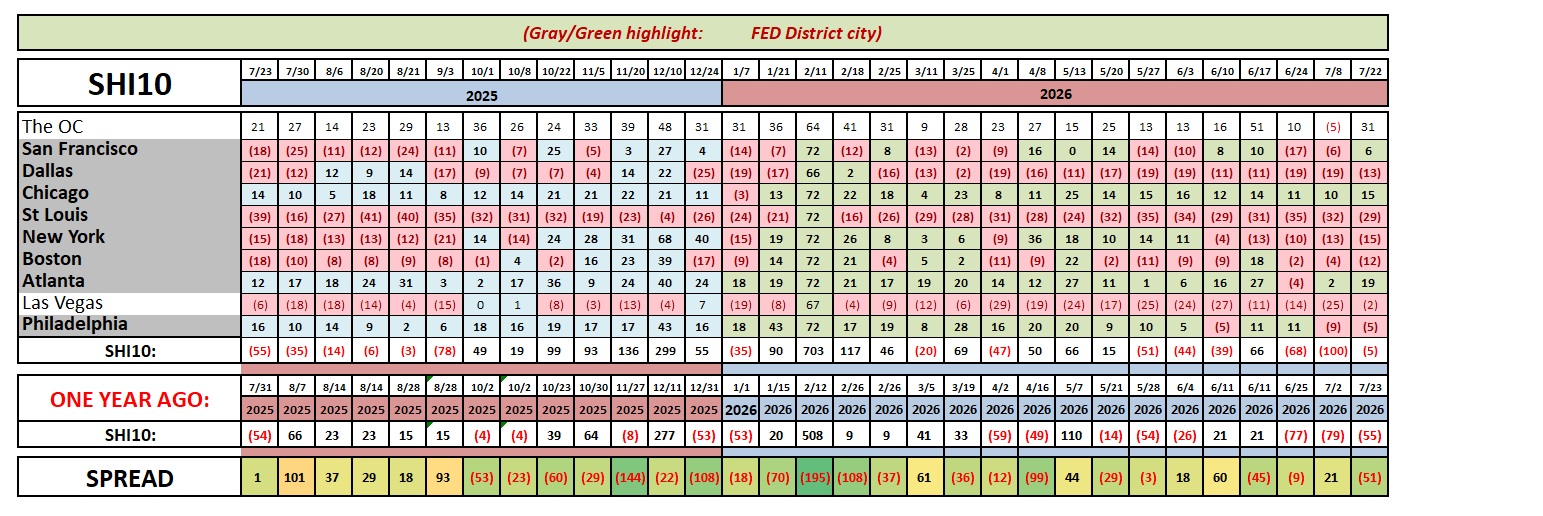
Last week, the SHI10 was extremely soft. Ironically, that has reversed this week:
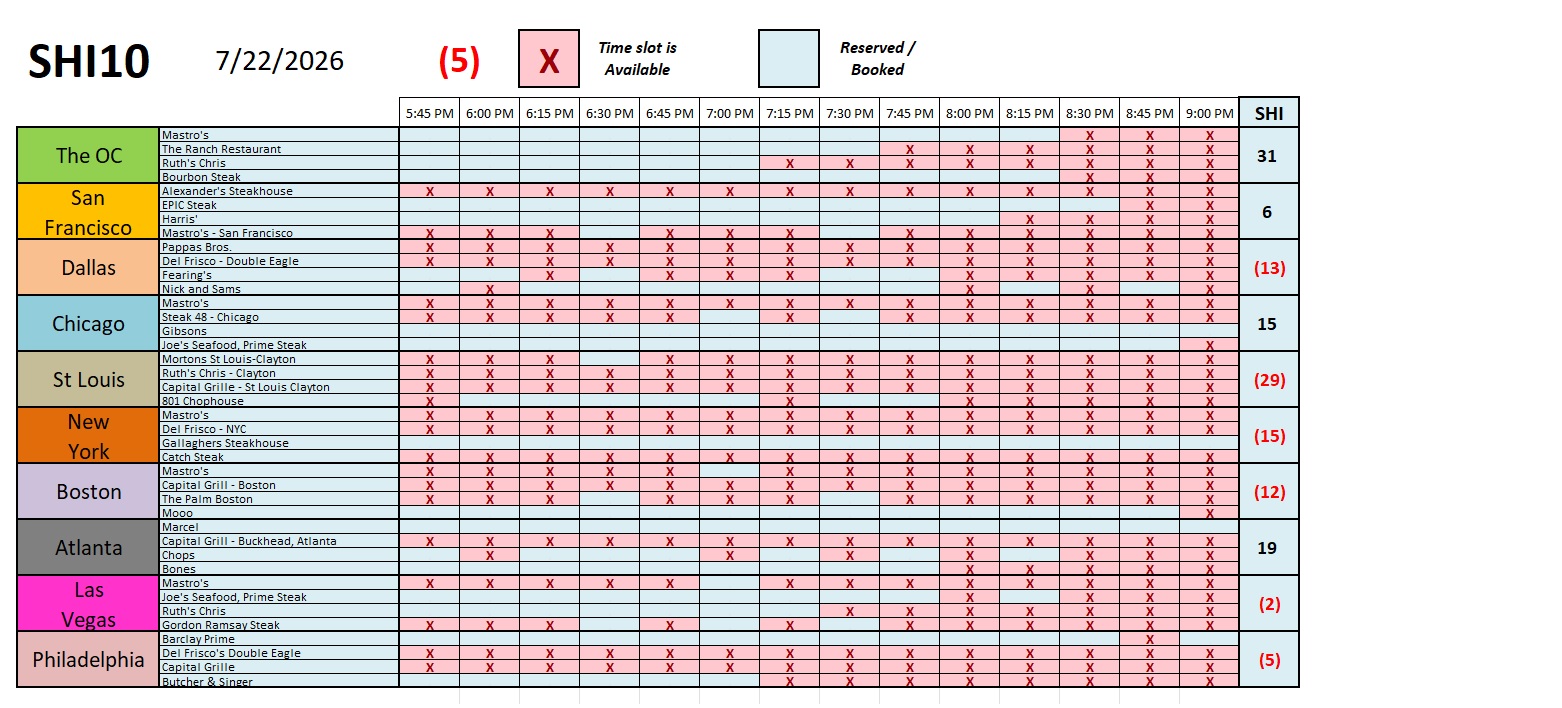
After dipping into the red last week, this week the SHI reading for the OC is pretty juicy. In fact, reservation demand improved in just about every marketplace. Take a look: