SHI 9.23.26 – Quarter Point Hike

SHI 9.17.26 — Central Banks
September 17, 2026
Here’s a NEWS RELEASE from last Wednesday:
NEW YORK, Sept. 16, 2026 /PRNewswire/ — The Bank of New York Mellon Corporation (“BNY”) (NYSE: BNY), a global financial services company, today announced that it will increase the Prime Lending Rate to 7.00%, effective Thursday, September 17, 2026.
Did you know that the “prime rate” is now 7%? The Prime Rate anchors many business and personal loans. Often, the rate the borrower pays is “prime plus” some percentage. A personal loan at the rate of “prime +3” would now put you at 10%. That is a far cry from the zero-rate loans from just 5 or 10 years ago.
“
Hamilton founded this bank
240 year ago. Amazing. “
“
Hamilton founded this bank
240 year ago. Amazing. “
I mention BNY here for two reasons.
First, to show how quickly the major banks raise interest rates following a FED hike. They all raised their prime rate the next day. And second, because this is really an amazing bank – Alexander Hamilton founded the bank in 1784. From that same press release:
About BNY: BNY is a global financial services platforms company at the heart of the world’s capital markets. For more than 240 years BNY has partnered alongside clients, using its expertise and platforms to help them operate more efficiently and accelerate growth. Today BNY serves over 90% of Fortune 100 companies and nearly all the top 100 banks globally. BNY supports governments in funding local projects and works with over 90% of the top 100 pension plans to safeguard investments for millions of individuals. As of June 30, 2026, BNY oversees $62.6 trillion in assets under custody and/or administration and $2.2 trillion in assets under management.
By the numbers, BNY is the largest “custodian” bank in the world and they “work with” over 90% of the Fortune 100 companies. Amazing.
But were not here to talk about BNY today. Today, we’re talking about interest rate hikes.
Welcome to this week’s Steak House Index update.
If you are new to my blog, or you need a refresher on the SHI10, or its objective and methodology, I suggest you open and read the original BLOG: https://www.steakhouseindex.com/move-over-big-mac-index-here-comes-the-steak-house-index/
Why You Should Care: The US economy and US dollar are the bedrock of the world’s economy. But is the US economy expanding or contracting?
Expanding … according the ‘advanced’ reading just released by the BEA, Q2, 2026 GDP grew — in ‘current-dollar‘ terms — at the annual rate of 8.0%.
The ‘real’ growth rate — the number most often touted in the mainstream media — was 1.50%. In current dollar terms, during Q2 the annual economic output reached almost $32.50 trillion.
According to the IMF, the world’s annual GDP will expand to over $126 trillion in 2026. Of that amount, the US makes up over 25% — expected to reach $32.4 trillion by the end of 2026. Further, IMF expects global GDP to reach almost $135 trillion by 2028 — an increase of more than 28% in just 5 years.
America’s GDP remains around 25% of all global GDP. Just four countries—the United States, China, Germany, and Japan—generate roughly half of all economic activity worldwide. Collectively, the US, the European Common Market, and China generate about 65% of the global economic output. These are the 3 big, global players. They bear close scrutiny.
The objective of this blog is singular.
It attempts to predict the direction of our GDP ahead of official economic releases. Historically, ‘personal consumption expenditures,’ or PCE, has been the largest component of US GDP growth — typically about 2/3 of all GDP growth. In fact, the majority of all GDP increases (or declines) usually results from (increases or decreases in) consumer spending. Consumer spending is clearly a critical financial metric. In all likelihood, the most important financial metric. The Steak House Index focuses right here … on the “consumer spending” metric. I intend the SHI10 is to be predictive, anticipating where the economy is going – not where it’s been.
Taking action: Keep up with this weekly BLOG update. Not only will we cover the SHI and SHI10, but we’ll explore “fun” items of economic importance. Hopefully you find the discussion fun, too.
If the SHI10 index moves appreciably -– either showing massive improvement or significant declines –- indicating growing economic strength or a potential recession, we’ll discuss possible actions at that time.
The Blog:
It’s ironic.
Many Americans are struggling. We all know inflation has pushed up food, shelter and medical costs. Post-Covid, life in American has become much more expensive.
The FED has assured those Americans – all of us, really – that they get it. “The committee will deliver price stability,” Kevin Warsh and the FED have assured us. And by ‘price stability’ they mean they will tackle inflation, tamping it down to no more than 2% per year.
As proof of their resolve, they increased interest rates last week. This action, we are assured by the FED, is a step in the direction toward controlling inflation and slowing the ever-increasing cost cycle.
There’s only one problem: Raising interest rates does the exact opposite. Raising interest rates actually increases costs for all Americans carrying variable rate debt. In fact, in the aggregate, that quarter point hike add about $4.5 billion per year in extra interest payments for Americans that owe floating rate debt. For context, it’s important to note that consumers with variable debt were paying more than $310 billion per year before the hike, so, in the big scheme of things, that quarter point hike isn’t the end of the world. It’s a small payment increase – only about 1.5% of the total – but it is an increase. Which, again, is the polar opposite of “price stability.”
So why does the FED raise interest rates when that action harms precisely the people “price stability” is intended to help?
Raising interest rates to stop or slow future price increases probably seems counterintuitive to you. Because it is. After all, the immediate aftermath of a rate hike is higher interest payments by Americans with variable debt.
That’s the challenge, really. A rate hike may seem insensitive and harmful to the very people the FED intends to help. Because it is.
However, the FED subscribes to the theory that all Americans must share some short-term pain to receive the longer-term gain: Price stability.
Do we? This is old economic theory — does it still hold true today?
Older folks may remember one of the worst episodes of price in-stability back in the 1970s. The annual inflation rate was out of control, peaking near 15% per annum in March of 1980. By that time, US wage and price increases were locked in a self-reinforcing negative feedback loop with entrenched inflation expectations.
To break the cycle, then chair Paul Volcker didn’t simply raise short-term interest rates: He raised them far above the expected inflation rate to that borrowing became truly painful. At one point in 1981, the Federal Funds Rate (FFR) was about 20%! Imagine a variable rate loan at the rate of “prime+2%” – at this rate the borrower would be paying the bank about 22% per annum.
It took years, but the FEDs strategy worked. Volcker definitely broke the inflationary cycle. And simultaneously, he almost broke the US economy. Home construction collapsed. Small businesses were devastated and many went bankrupt. And people lost their jobs: The unemployment rate rose to 10.8%.
The debate then as now remains: Is the “medicine” (rate hikes) worse than the “disease” (runaway inflation)? It’s a question we won’t answer here. Because there isn’t really a single answer. As with most economic debates, the answer depends on who you ask.
In 1990, Paul Volcker gave a lecture titled, “The Triumph of Central Banking?” His view was the FEDs campaign was successful. Over the years, Volcker opined that the real danger of the 1970s wasn’t inflation itself, but the loss of confidence in the dollar and US monetary policy. That was the true problem, he felt. Because once a belief that inflation was out of control became deeply embedded by most Americans, the US economy would struggle as all “normal” economic relationships became distorted. Academically, I get it. And I agree.
In 1982 my mother-in-law’s business failed. She owned a residential real estate brokerage business she had begun a couple decades earlier. Her company was well run and had been very successful for many years. Of course, a large part of that success in the 1960s and 1970s resulted from home price increases triggered by the year-after-year inflation. Housing cost increases were a big part of consumer price increases during this period. The two were highly correlated and causation was clear.
By the time 1980 rolled around and home loan rates approached 18.00% per year, the housing market broke, and home sale numbers finally plummeted. Nationally, new home sales were down almost 50%, while existing home sales – the kind my mother-in-law specialized in – were down by about 1/3.
In California, the numbers were similarly abhorrent — actually worse. While the late 1970s were lovely years for those in housing, the paradigm shifted as 1979 ended. Thereafter, existing home sales rates simply collapsed year after year. Take a look:
Year |
Annual sales |
Change |
1977 |
466,187 |
+2.5% |
1978 |
491,974 |
+5.5% |
1979 |
477,526 |
−2.9% |
1980 |
377,664 |
−20.9% |
1981 |
271,244 |
−28.2% |
1982 |
189,345 |
−30.2% |
Looking at the “Annual sales” figures above, it’s easy to see the inverse correlation between home sales and the FED funds rate (FFR). The higher the FFR, the lower the home sales. The FFR hikes had the same horrific impact on the economy at large: The US quickly slid into multiple deep and lengthy recession. The FFR hikes triggered a lengthy series of knock-on effects. US bankruptcies skyrocketed. Jobs were lost at the fastest rate since the great depression, reaching an unemployment rate of 10.8% at it peak. And the FFR spikes spelled doom for the Savings and Loan Industry. Nowhere is that easier to see than in the chart below, provided by our friends at the St. Louis FED. The title of the series is “Failures of all institutions for the United States and Other Areas.” In this case, the institutions failing were the S&Ls and these failures played out as the FFR remained chronically high thru the 1980s:
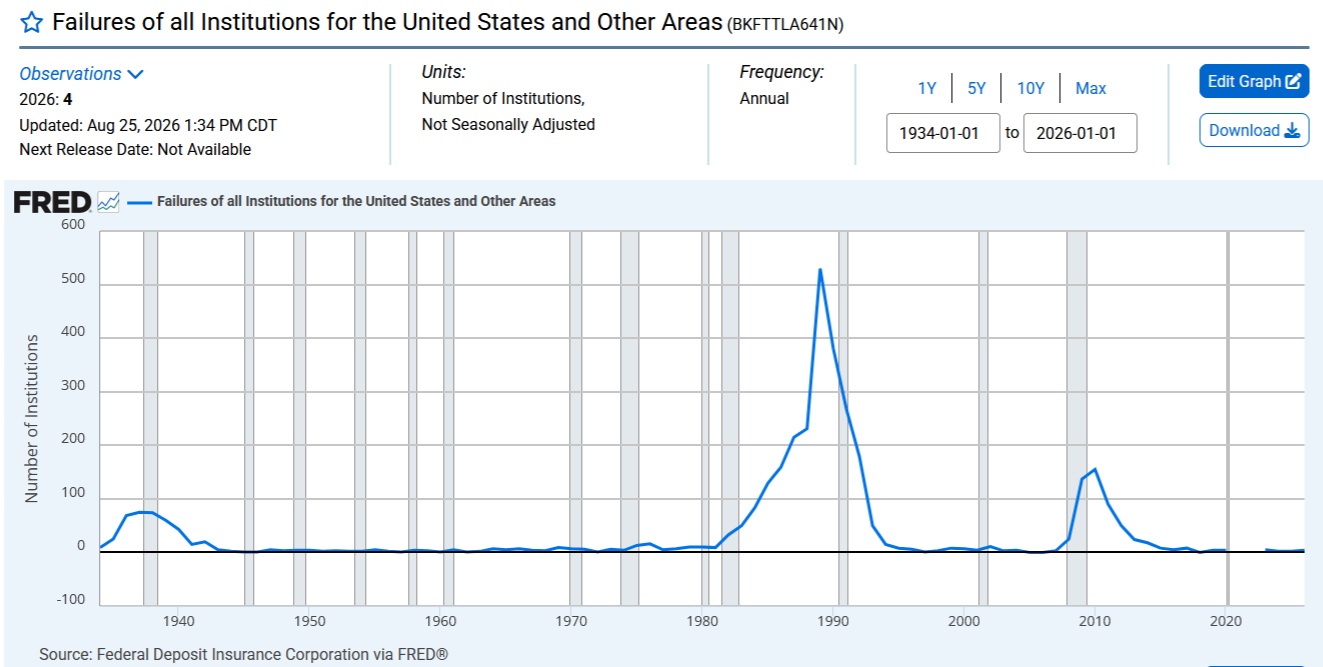
The episode was simply staggering.
Back to the earlier 1980s, by late in 1982 my Mom-in-law could hold on no longer. As her real estate sale’s revenue plummeted, along with home sales, she went broke. She lost her business and livelihood. I never got the chance to ask her if she agreed with Chairman Volcker’s comments; however, I am confident she would not. I assure you she would say the medicine was far worse than the disease. I was too young, or too oblivious, to notice.
Higher rates hurts anyone who is a borrower. Americans carry more than $1.26 trillion in credit card debt. A quarter point raise there increases annual cost by more than $3 trillion. Of course, it’s no surprise that the income group most adversely impacted by a FED rate hike is the bottom quartile. They carry the most credit card debt.
Then why does the FED do rate hikes? Because that’s one of the few “tools” they have to manage inflation and the economy at large. Admittedly it’s a blunt tool — one that often harms people. Plainly stated, the pain borrowers feel from the rate hike is not a side effect the FED is trying to avoid: It is actually the way the machinery works. It is intentional. Rate hikes work precisely because they make credit more expensive and discourage additional spending. If nobody felt the pinch from a rate hike, the FED couldn’t slow the US economy. The pain is the tool. The pain is the FEDs intended objective. This is the primary lever they use slow the economy, objectively to slow inflation.
Is this best inflation-fighting tool available to the FED today? Yeah, it probably is. The general consensus among economists is that FFR hikes work precisely because they are blunt. The effects are widespread. They reach every corner of the economy simultaneously. Everyone, together, “takes the medicine.” Sure, some people and sectors feel the pain more intensely. But everyone feels the pain.
I think it’s time for a glass of wine! 🙂
To the steakhouses!
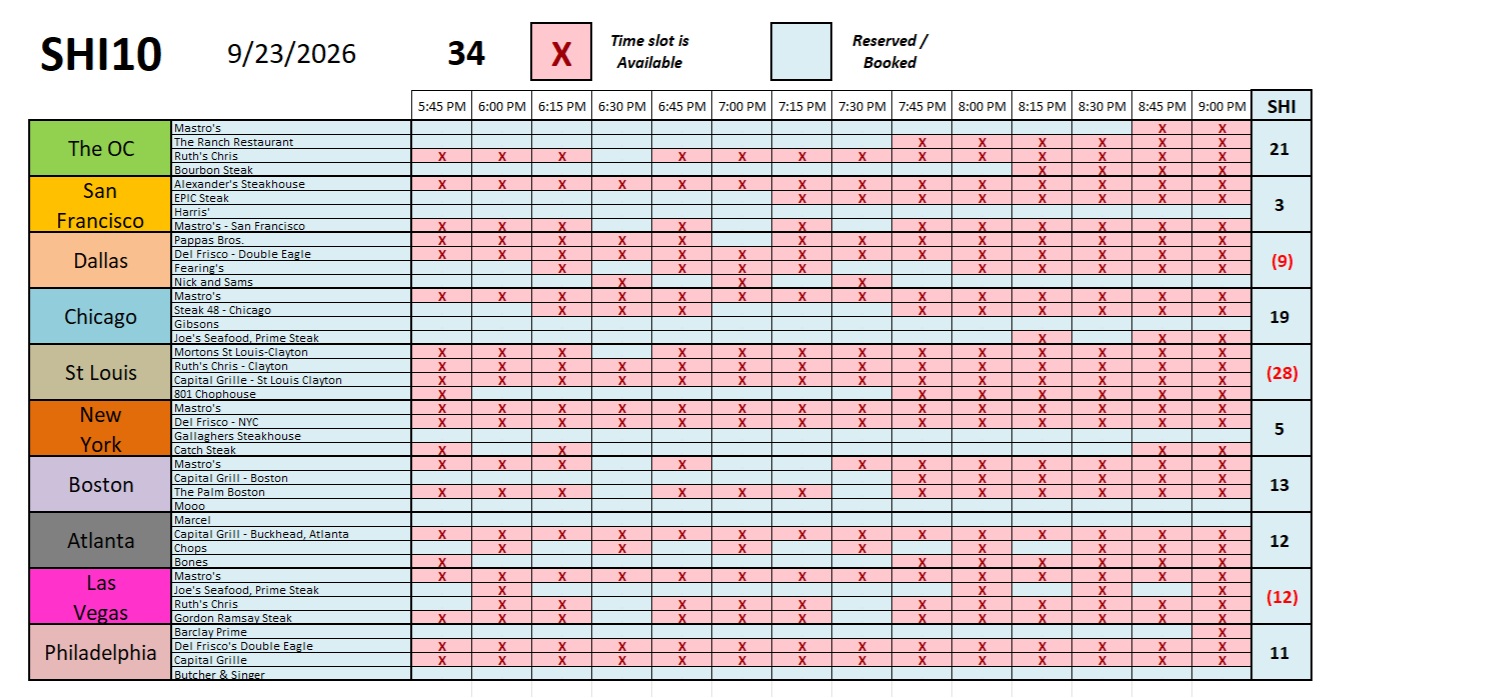
Once again, the SHI numbers are fairly consistent. Some markets saw reservation demand growth, some fell. But in the aggregate, demand for expensive eatery reservations remains strong.
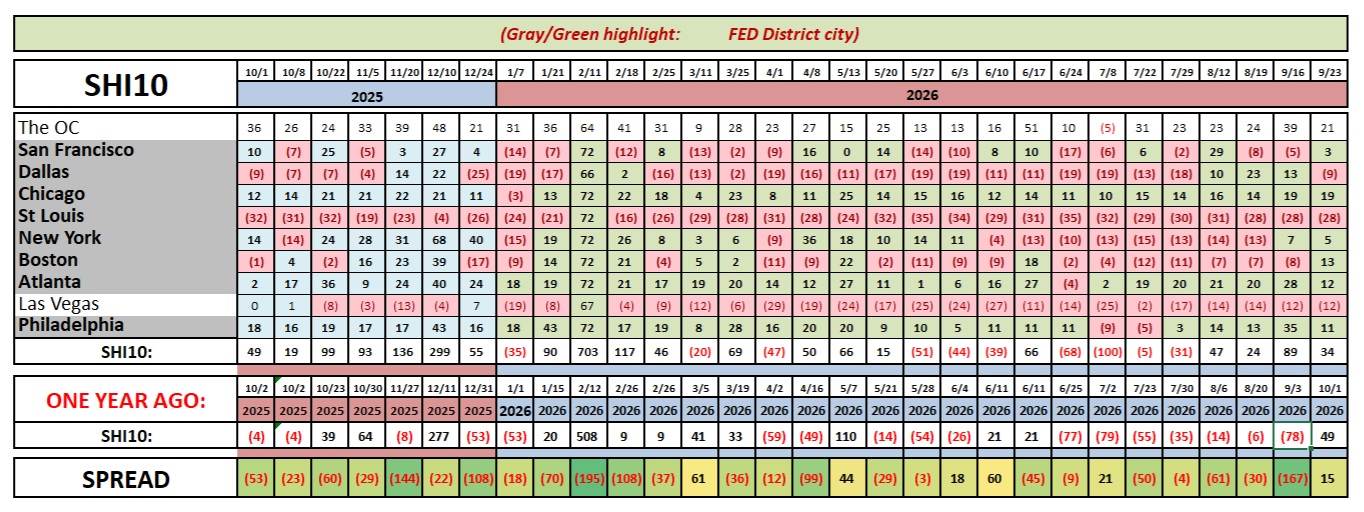
I have commented in prior blogs that the US economy is super “hot,” firing on all cylinders. The latest current-dollar GDP annualized growth figure was 8.0%. This is a smoking-hot number. Yes, when “deflated” by the inflation factors, the number is far lower. But as I always say, we live in a “current dollar” world, not one that is inflation adjusted.
At 9:45 AM eastern today, the “S&P Global Flash US PMI” for September was released. PMI is short for the “Purchasing Managers’ Index.” The PMI is built from monthly surveys of purchasing managers — the executives at manufacturing and service companies who make decisions about buying inventory, materials, and services. They are asked if conditions (new orders, production, employment, prices, delivery times, and so on) got better, worse, or stayed the same compared to the previous month. The September reading cam in at 58.4 — a 54 month high.
The S&P Chief Business Economist, Chris Williamson, characterized the state of our economy this way:
“US business continues to boom, with output growing at the fastest rate for over five years in September. Historical comparisons suggest that the latest survey data point to annualized growth of around 5% with a 4% gain now signalled for the third quarter as a whole.
“To put the growth surge in context, barring the spike in demand following the opening up of the economy after the COVID-19 lockdowns, the latest improvement in business activity is the greatest recorded since early 2015. Business is clearly booming now in both manufacturing and services.
“However, this growth is being accompanied by some of the most severe supply chain bottlenecks seen in the near-two-decade survey history if the pandemic is excluded, with companies also reporting increasing problems finding suitable staff. Backlogs of work are consequently rising sharply. While this accumulation of uncompleted orders bodes well for the further expansion of output and capacity in the coming months, it also indicates that companies are developing more pricing power, and hence is a worry for the inflation outlook.