SHI 9.17.26 — Central Banks

SHI 8.19.26 – Thin Air
August 20, 2026
SHI 9.23.26 – Quarter Point Hike
September 23, 2026
I’m back! Did you miss me?
And if you didn’t miss me, did you at least miss my blog? It’s been about a month since my last post.
Please say yes; I’d hate to think you didn’t notice. 🙂
I was traveling in Europe with my lovely wife. Among others, we visited Amsterdam, Cologne, Strasbourg, Basel, Heidelburg, Luxembourg, Verdun, Reims, Epernay and Paris. The trip was long; but great. It’s great to be home.
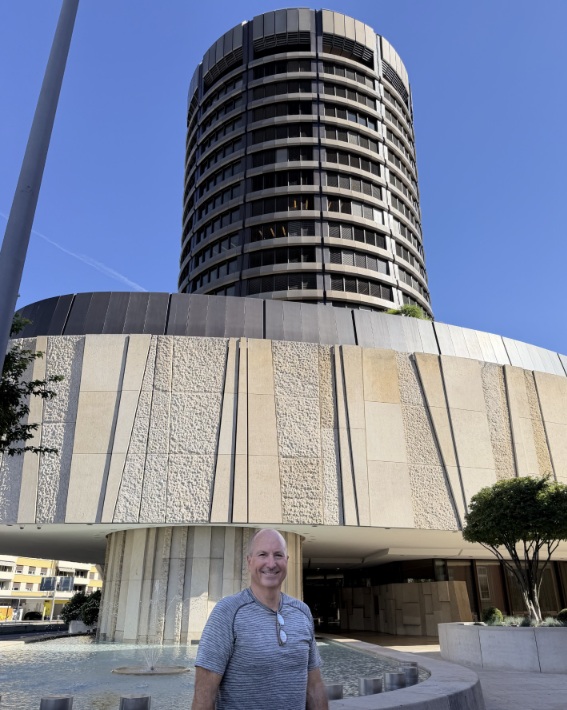
The economic highlight on the trip, however, had to be this:
“
Yes, that’s me. “
“
Yes, that’s me. “
And the building behind me? That’s where central bankers from across the developed economic world meet. That, my friends, is the Bank for International Settlements. I was in Basel, Switzerland for a couple of days so, of course, I had to visit the BIS! No, I didn’t go inside. I did get a warning, however, from the local police watching the building: Crossing a street, against a red light, is an 80 euro fine. Even crossing a small street without any traffic requires a green light. I assured the officers I would not do that again.
This week, of course, all economic eyes are on our very own US central bank. Yesterday, the FED raised their short-term federal funds rate by 25 basis points. Why raise rates now? What drove that decision?
Contrary to what you may have gleaned from the financial media, it’s not the elevated inflation rate. Sure, that contributed to the decision, but it is far more complicated than that. Let me explain.
Welcome to this week’s Steak House Index update.
If you are new to my blog, or you need a refresher on the SHI10, or its objective and methodology, I suggest you open and read the original BLOG: https://www.steakhouseindex.com/move-over-big-mac-index-here-comes-the-steak-house-index/
Why You Should Care: The US economy and US dollar are the bedrock of the world’s economy. But is the US economy expanding or contracting?
Expanding … according the ‘advanced’ reading just released by the BEA, Q4, 2025 GDP grew — in ‘current-dollar‘ terms — at the annual rate of 5.1%.
The ‘real’ growth rate — the number most often touted in the mainstream media — was 1.40%. In current dollar terms, 2025 US annual economic output reached almost $31.50 trillion.
According to the IMF, the world’s annual GDP will expand to over $126 trillion in 2026. Of that amount, the US makes up over 25% — expected to reach $32.4 trillion by the end of 2026. Further, IMF expects global GDP to reach almost $135 trillion by 2028 — an increase of more than 28% in just 5 years.
America’s GDP remains around 25% of all global GDP. Just four countries—the United States, China, Germany, and Japan—generate roughly half of all economic activity worldwide. Collectively, the US, the European Common Market, and China generate about 65% of the global economic output. These are the 3 big, global players. They bear close scrutiny.
The objective of this blog is singular.
It attempts to predict the direction of our GDP ahead of official economic releases. Historically, ‘personal consumption expenditures,’ or PCE, has been the largest component of US GDP growth — typically about 2/3 of all GDP growth. In fact, the majority of all GDP increases (or declines) usually results from (increases or decreases in) consumer spending. Consumer spending is clearly a critical financial metric. In all likelihood, the most important financial metric. The Steak House Index focuses right here … on the “consumer spending” metric. I intend the SHI10 is to be predictive, anticipating where the economy is going – not where it’s been.
Taking action: Keep up with this weekly BLOG update. Not only will we cover the SHI and SHI10, but we’ll explore “fun” items of economic importance. Hopefully you find the discussion fun, too.
If the SHI10 index moves appreciably -– either showing massive improvement or significant declines –- indicating growing economic strength or a potential recession, we’ll discuss possible actions at that time.
The Blog:
Jet lag has ensured this will be a brief post.
I’m sure I’ll be more awake and coherent next week. 🙂
Just like investors and commercial banks, Central Banks use risk as the foundational metric in their decision making process. All decisions begin with a risk assessment. And the issue is bi-directional: Acting and failure to act both have their own integral risks. This is true for every statement, policy decision, rate decision, etc., for every central banker the world over.
Why did the FED choose to raise the federal funds rate yesterday?
Collectively, they weighed the risks of doing nothing at this time or, alternatively, taking action. In the aggregate, clearly, they decided the risks of doing nothing surpassed the risk of a 25 basis point hike. In their statement, they framed the decision as a “price stability” choice. They suggested elevated inflation levels ultimately moved the needle to the “GO” call. And while I believe that is true, the decision was more complex than that.
First, the rate increase was widely expected. The global financial markets were not surprised by the move. The FED had “cover” to make the call without creating excessive financial disruption. This is not always the case.
Senator Elizabeth Warren has called the new FED chairman Warsh a Trump “sock puppet.” By that comment, she suggested his rate decisions would not be independent. Trump has recently commented he believes the funds rate should be 1% — far lower than the current rate. By choosing to raise rates now, against the wishes of the President, Warsh was able to demonstrate he is not simply doing Trump’s bidding.
The FED has repeated they will deliver price stability. Their credibility is on the line with every decision. I believe this one enhances their credibility.
I agree with the FED that both monetary and fiscal policies are not restrictive. Both support economic expansion. A quarter point rate hike makes monetary policy slightly more restrictive: enough to make a point but not enough to change the direction of our economic expansion.
AI is permanently in the news. Lately the debate over survival of the human race has been paramount. That’s a worthwhile debate. Another is the potential productivity enhancement from AI. Warsh and many other economic experts agree: AI triggered productivity growth can be deflationary. I think he’s been waiting to see if this develops. Thus far, we haven’t seen much here. Time will tell … but the debate remains.
In the interim, elevated inflation (in all metrics like the CPI, PCE, PPI, etc.) is real and readily observable. This suggests a small rate hike now is intelligent.
The FED has a “dual mandate.” Both price stability and full employment. Our labor market remains strong. The unemployment rate remains low and stable. A small hike is likely to make no difference here.
America’s “net worth” has almost reached $200 trillion. Check out the latest FED report called the Z.1: Financial Accounts of the United States. It’s downright amazing. Anyway, the financial wealth of Americans is clearly supporting consumer spending and the economy at large. Oddly enough, a small rate hike, in some respects, is actually beneficial to all the Baby Boomers who have money in the bank.
Finally, AI capital expenditures remain at spectacular levels, supporting the economy at large. The US economy is sizzling hot. Consider this:
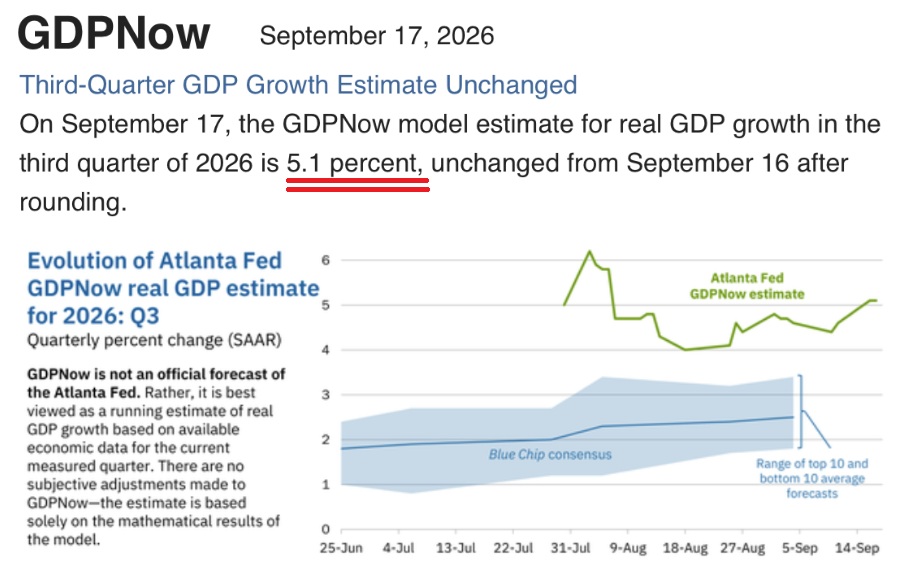
A 5.10% ‘real’ GDP growth rate probably translates to something between 8-10% on a current dollar basis. This is amazing. And it might be too amazing. The economy runs the risk of overheating. Broadly speaking, over the long run, the interest rate on the 10-year US Treasury has tended to be close to the current-dollar, or nominal, GDP growth rate.
Thru that lens, the 10-year treasury should be closer to 8%. Crazy talk, right? Anyway, the economy is running hot and can easily absorb a rate hike or two today.
The downside of rate hikes? Unfortunately, higher rates harm both the housing markets and lower income Americans. I’m confident Warsh and the FED considers both when making their decision.
To the Steakhouses!
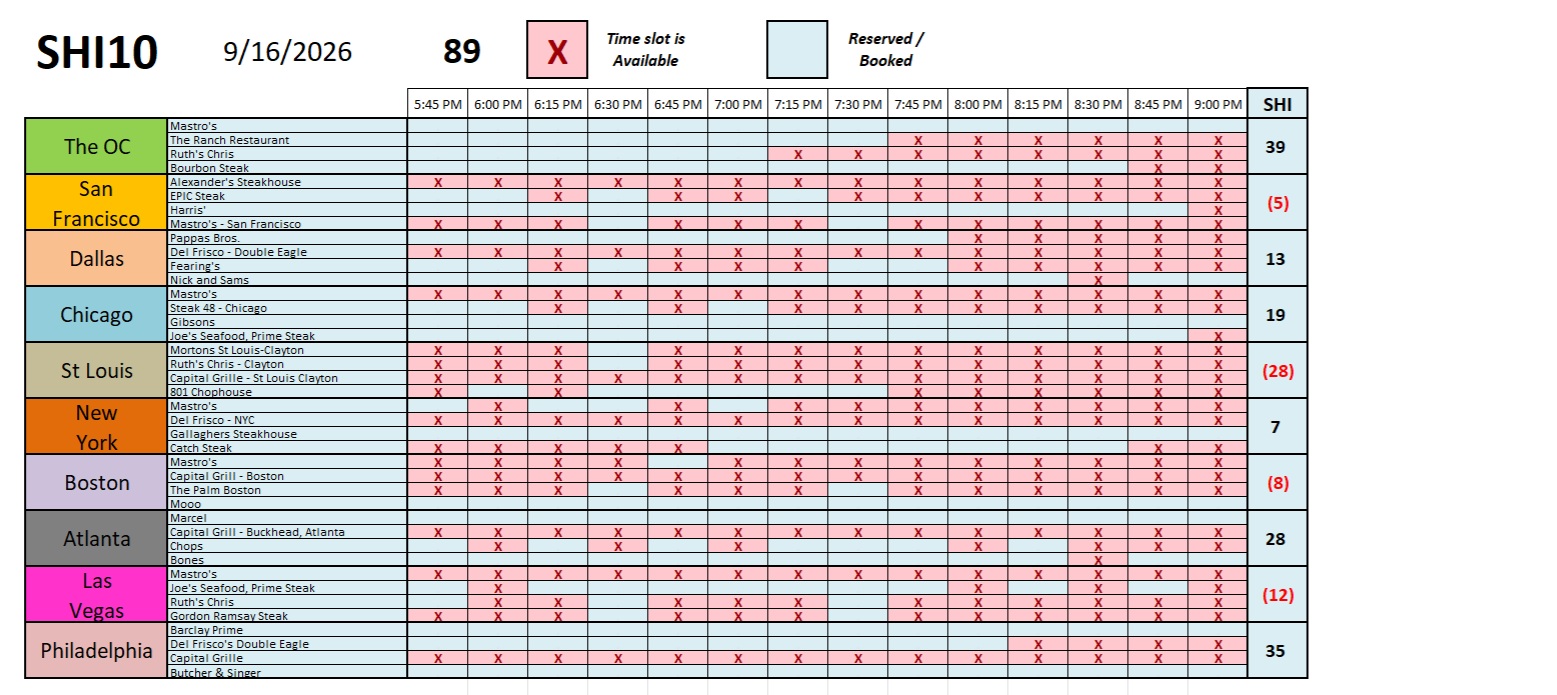
We see improvement in reservation demand in most SHI markets. Look: NYC went green!
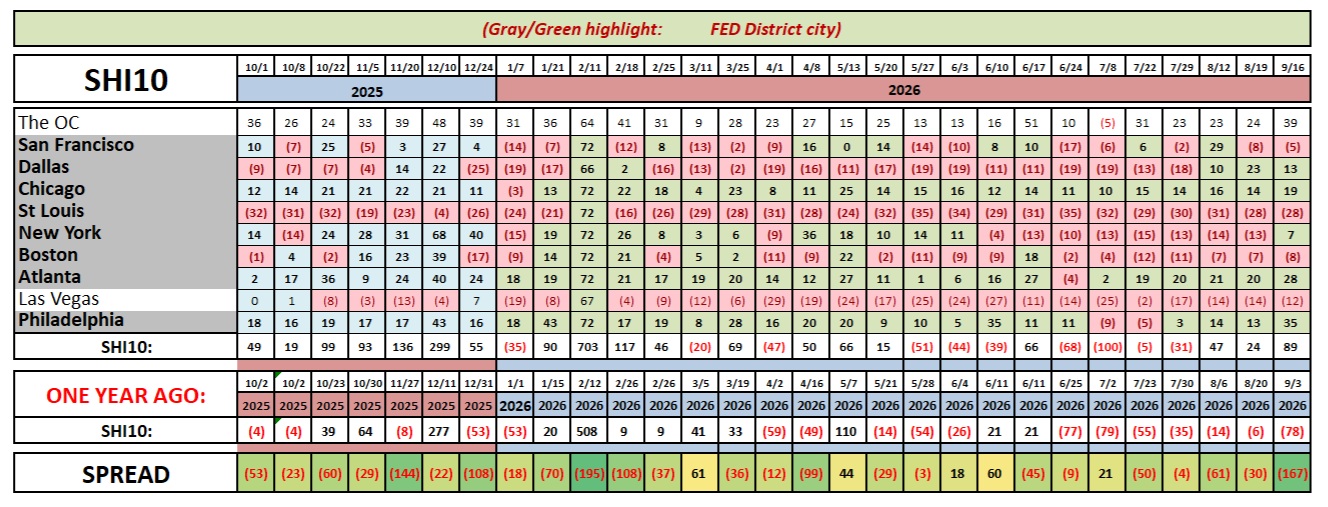
Thanks for tuning in. More next week when I’m back on Pacific time. 🙂
<Terry Liebman>