SHI 11.25.26 – What Did I Miss?

SHI 11.11.26 – At The Intersection of Economics and Politics
November 11, 2026
A lot. It’s been a busy 2 weeks, my friends.
But before I get to that, please accept an apology. Last week’s blog was pretty much in the can when I discovered that the ‘Steak House Index’ website was down. That’s right. Dead as a doornail. I couldn’t post anything. It was two days before my hosting service could fix the problem. Was I, too, the victim of a malicious hack? Was this just another AI cyberattack in a sea of cyberattacks and outages across America? Is AI out there, congregating in some dark corner of the web, already conspiring and acting against humans? Could our days be numbered already?
The consumer hordes at Costco stocking up on bottled water and toilet paper seem to think so. Do they believe water and TP will protect them from the coming AI apocalypse?
Who knows. But I don’t. No, I think is this is the bottom line: I agree with the experts who feel we have opened the digital Pandora’s box.
“
Don’t blink. You might miss it. “
“
Don’t blink. You might miss it. “
For decades, software bugs lay dormant, undiscovered, and benign within global technology systems. That all changed in a big way with Anthropic’s ‘Claude Mythos.’ Once opened, the digital Pandora’s box cannot be closed again. The bugs are awake, scurrying about, and the race to find them all has begun. The ‘white hats’ want to find them, patch them, fix them, eliminate the problem before it becomes a problem, while the ‘black hats’ seek havoc and maybe the chance to make a few digital bucks.
Could this theory be wrong? Sure. But after listening to a lot of experts on the topic, considering that which we know to be true, I’m guessing this is the culprit for the outages we’ve experienced.
Even worse news, in my opinion, is the fact that this is likely the new normal. As we all know, we live in a complex, digital world today. Updates, patches, and fixes are likely to become far more frequent than ever before. Which means more digital stuff is going to break. Before it gets fixed. I fear it’s going to be a bumpy ride.
In a November 18 interview with Andrew Ross Sorkin, Satya Nadella, the CEO of Microsoft shared his belief that AI is discovering software vulnerabilities at an unprecedented rate. Further, traditional software testing process is breaking down. In the past, for example, Microsoft might spend a week testing a software patch for a critical banking system. No longer. Speed is mandatory and haste makes waste: Insufficiently tested software patches add a new type of instability. Nadella further commented that new AI tools allow individuals to mount sophisticated attacks only previously associated with nation-states. It’s definitely going to be a bumpy ride.
OK, shall we move on? It’s been a busy two weeks since my last post. And I still owe you an explanation of just how bad moving data center construction overseas would be for the US economy.
Let’s get started.
Welcome to this week’s Steak House Index update.
If you are new to my blog, or you need a refresher on the SHI10, or its objective and methodology, I suggest you open and read the original BLOG: https://www.steakhouseindex.com/move-over-big-mac-index-here-comes-the-steak-house-index/
Why You Should Care: The US economy and US dollar are the bedrock of the world’s economy. But is the US economy expanding or contracting?
Expanding — significantly — according the ‘final’ reading just released by the BEA, Q3, 2026 GDP grew — in ‘current-dollar‘ terms — at the annual rate of 6.20%.
The ‘real’ growth rate — the number most often touted in the mainstream media — was 1.50%. In current dollar terms, during Q2 the annual economic output reached more than $33 trillion.
According to the IMF, the world’s annual GDP will expand to over $126 trillion in 2026. Of that amount, the US makes up over 25% — expected to reach $32.4 trillion by the end of 2026. Further, IMF expects global GDP to reach almost $135 trillion by 2028 — an increase of more than 28% in just 5 years.
America’s GDP remains around 25% of all global GDP. Just four countries—the United States, China, Germany, and Japan—generate roughly half of all economic activity worldwide. Collectively, the US, the European Common Market, and China generate about 65% of the global economic output. These are the 3 big, global players. They bear close scrutiny.
The objective of this blog is singular.
It attempts to predict the direction of our GDP ahead of official economic releases. Historically, ‘personal consumption expenditures,’ or PCE, has been the largest component of US GDP growth — typically about 2/3 of all GDP growth. In fact, the majority of all GDP increases (or declines) usually results from (increases or decreases in) consumer spending. Consumer spending is clearly a critical financial metric. In all likelihood, the most important financial metric. The Steak House Index focuses right here … on the “consumer spending” metric. I intend the SHI10 is to be predictive, anticipating where the economy is going – not where it’s been.
Taking action: Keep up with this weekly BLOG update. Not only will we cover the SHI and SHI10, but we’ll explore “fun” items of economic importance. Hopefully you find the discussion fun, too.
If the SHI10 index moves appreciably -– either showing massive improvement or significant declines –- indicating growing economic strength or a potential recession, we’ll discuss possible actions at that time.
The Blog:
Let’s start with a few incredible events: During this past 2 weeks, not only did Jensen Huang resign from Nvidia … but then he came back! The AI behemoth Anthropic executed the largest IPO in history, closing in on a $2 trillion valuation for a brief time. Very brief. 🙂
The FAA shut down the national flight system. Technology outages bloomed like spring flowers. The stock markets plummeted! And then soared!
It’s been a busy 2 weeks. But the Nvidia “thing” stands out in my book. In fact, I think we can now safely tag Huang with a single name. Jensen. As with Cher, Sting, Elon and LeBron, no last name is needed.
Chamath Palihapitiya, a Silicon Valley VC investor and podcaster from the “All In” podcast, recently shared his opinion that in the AI chip world, “Jensen was biblically good,” he commented. It’s hard to argue with that. I suspect most people would have agreed — before Jensen’s revelations and resignation. The stock markets definitely agreed, quickly punishing the Nvidia stock price after his resignation, and the financial markets as a whole.
I agree. Jensen was biblically good. Until he was biblically bad. Which he was — in the biblical sense. And then he was reinstated. Wild. You can’t make this stuff up. Once again, it’s proven that truth is stranger than fiction. Perhaps we’ll learn more a week from tomorrow when Jensen testifies before Congress. But until the facts are known, I’ll reserve judgement — something most folks in the media seem incapable of doing.
Lets talk about data centers and US GDP. Here’s the question:
How might a 2028 national data center ban impact GDP?
Badly. Assuming 2027 is pretty much baked — those projects are generally already approved — my calculations suggest a ban on new data center buildings starting January 1, 2028 would cost the US economy roughly $100 billion in 2028, or about 0.3% of GDP. Let’s dig into he numbers and estimates I’ve built from public data.
Goldman Sachs has projected that Amazon, Alphabet, Microsoft, Oracle and Meta will likely spend about $1.2 trillion on AI infrastructure in 2027 and about $1.4 trillion in 2028. I no longer believe this amount of spending is possible, but its what the analysts believe — these are not forecasted budgets. The Wall Street consensus for 2027 is about $1.1 trillion. Also keep in mind these are global figures, not US-only.
So let’s assume the right annual CapEx number is a trillion dollars.
Remember, this is a hypothetical 2028 moratorium. Nothing like this is actually proposed. And before we go there, it’s important to note that a 2028 building moratorium will not stop the completion of current projects. AI servers and all the requisite equipment will be installed within existing and in-construction data centers.
A moratorium would stop new construction. So the right starting point is construction spending, not just hyperscaler CapEx.
And that spending has absolutely exploded. So much, in fact, some feel it is crowding out the construction of residential- and office-construction nationwide. The Census Bureau reports that private data center construction reached a record annual rate of $96.5 billion in September 2026. That is up about 90% from a year earlier. For comparison, data center construction was roughly $40 to $45 billion in 2025 — and that number was already elevated. A moratorium would effectively eliminate about a $100 million of US construction in 2028.
That is about 0.30% of GDP. Per year. After 2028, the total extent of the damage depends on our assumptions. And since this is a worst-case scenario, let’s assume in addition that in addition the construction loss, the ban also leaves the United States lacking the computing capacity that would have been housed within those US data centers. In this moratorium scenario, each year AI computing outside the US grows — but within the US computing is static. Even worse, all the products and services required to support the expanding base of data centers moves overseas: The electricity, other utilities, maintenance, replacement leaves with the data centers. Year after year, this compounds.
Quantifying that loss is more guess that fact. But if we lose about $100 billion of new buildings, we can assume a fixed level of missing annual capacity. I’m picking a midpoint of $50 billion in this hypothetical. Assuming that is what happens, the accumulation of American GDP that moves overseas looks like this:
|
Year |
GDP without ban |
Loss: construction only |
Loss: capacity gap |
|---|---|---|---|
|
2028 |
$35.00T |
$100B |
$100B |
|
2029 |
$36.35T |
$100B |
$150B |
|
2030 |
$37.74T |
$100B |
$200B |
|
2031 |
$39.18T |
$100B |
$250B |
|
2032 |
$40.65T |
$100B |
$300B |
|
2033 |
$42.19T |
$100B |
$350B |
|
Cumulative, 2028 to 2033 |
$600B |
$1.35T |
The numbers are large, but for context lets look at the capacity gap as a percent of GDP:
| Year | GDP without ban | Construction only | Capacity gap |
|---|---|---|---|
| 2028 | $35.00T | 0.29% | 0.29% |
| 2029 | $36.35T | 0.28% | 0.41% |
| 2030 | $37.74T | 0.27% | 0.53% |
| 2031 | $39.18T | 0.26% | 0.64% |
| 2032 | $40.65T | 0.25% | 0.74% |
| 2033 | $42.19T | 0.24% | 0.83% |
| Cumulative, 2028 to 2033 | $231.1T | 0.26% | 0.58% |
Do the numbers look smaller than you expected. Well, remember we’re talking GDP growth here. Most AI spending goes to servers and chips, and much of that hardware is imported. Imports reduce GDP levels. (More on that below.)
Second, while a $100 billion loss in 2028 lowers the level of GDP by about 0.3%, it also trims 2028 real growth by about 0.3 percentage point. That’s significant. If we assumed a base-line real growth rate of 3.00%, that’s about 10% of all GDP growth — shaved off in 2028. And this shortfall grows by $50 billion a year.
Finally, this analysis ignores multiplier effects, and other disruptions. I suspect my numbers are low by a factor of 2X or 3X for this reason.
The bottom line: Let’s all hope a nationwide ban on new data centers doesn’t happen. It would be exceptionally costly and economically foolish for the US. It probably would not trigger a recession — but it might. It’s hard to game out all the secondary and tertiary downstream implications. But if regulatory backlash pushed US production of new AI services abroad, the annual loss to US GDP would be massive.
Let’s get a glass of wine and head to the steakhouses.
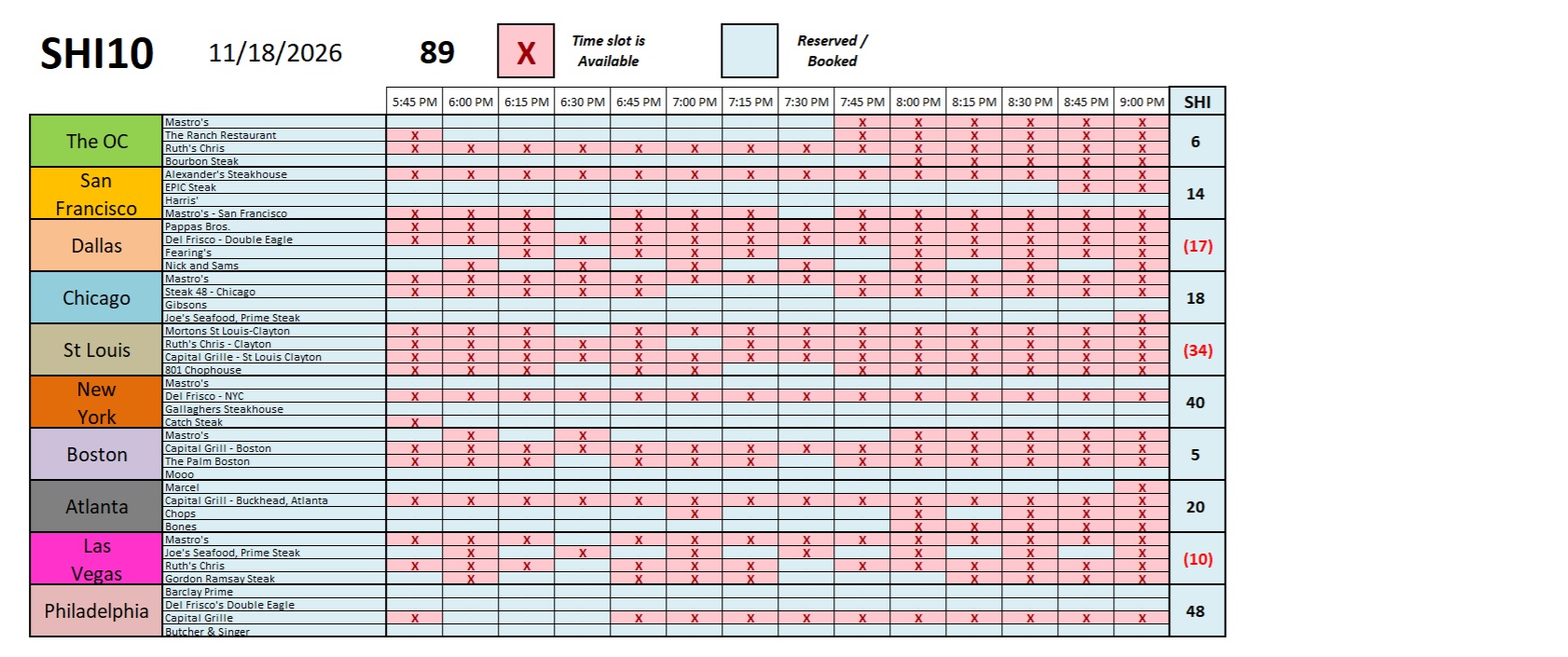
Note: This is last week’s SHI10. Why? Well, tomorrow is Thanksgiving. I suspect the holiday will have an outsized impact on reservation demand this weekend. And since I had last week’s numbers already done, I decided to post those here instead of data that would be far less useful.
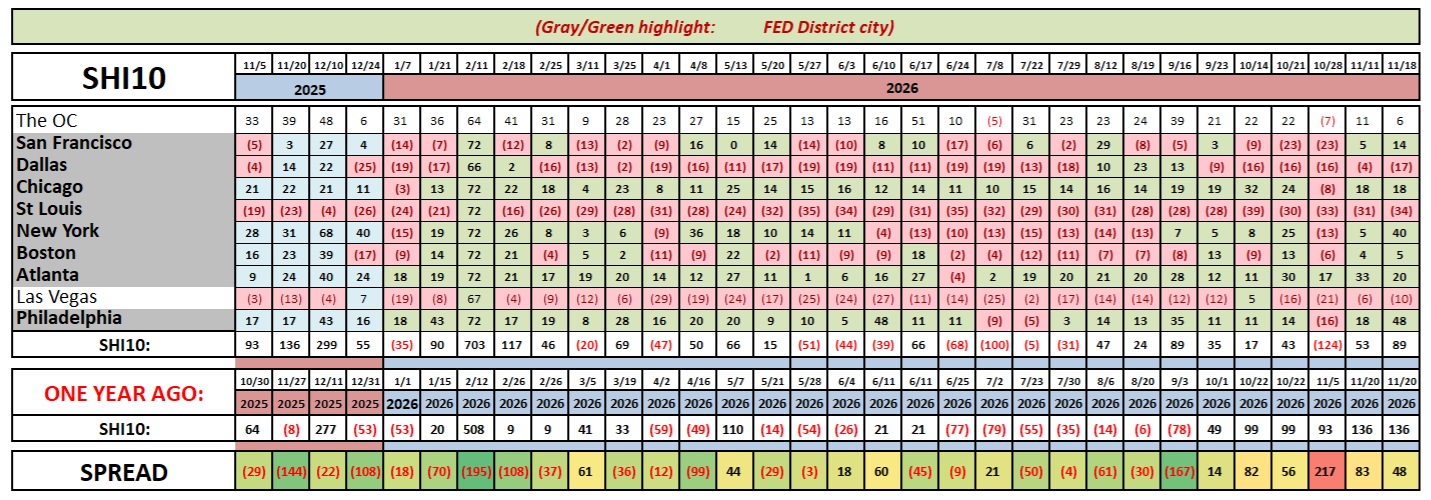
And once again, the SHI gives us little to chew on. Reservation demand is strong. And this fact is well supported by today’s GDP release, as discussed below.
Look, there’s no doubt, it’s noisy out there. It’s hard to separate the essence from the innuendo today. Paraphrasing Will Rogers talking about the Oklahoma weather, “If you don’t like ____________, wait a minute.” Fill in the blank. But in the final analysis, distilling down all the noise and the data, the politics, the arguments over AI, the demise of humanity, and everything else, the US economy remains solid.
Rock solid. The annual run rate for US GDP eclipsed $33 trillion in Q3. That’s right: According to BEA numbers released earlier this morning, real GDP growth in Q3 was 4.3%. That is a blistering growth rate.
Even more staggering: The year-over-year growth rate for my preferred metric, ‘nominal’ or current-dollar GDP growth, came in at 6% annualized. Absolutely staggering. And that’s deducting the negative result from imports. Had the export/import balance been zero, the quarter’s GDP growth rate would have been 6.8%!
Sure, sure, my detractors might comment I’m missing the fact that the AI infrastructure boom is the wind beneath the economy’s wings. And while that is most assuredly true, it really doesn’t matter. Because one dollar spent in the US economy, whether in consumer spending or capital expenditure, is one dollar spent in the US economy. I believe we will pay a price later when the CapEx slows, but I really don’t envision this outcome for years. It’s bound to happen … we just can’t say when. It’s easy to get distracted today by all the noise. And until then, those dollars are spent and then circulate inside the US economy.
Which is why I titled this blog, “What Did I Miss?” Indeed. But in the final analysis, it’s still just a lot of noise masking the reality: I remain confident we are experiencing a once-in-a-century economic transformation.
Happy Thanksgiving!