SHI 6.17.26 — The New Federal Reserve

SHI 5.10.26 — Should YOU Build a Data Center?
June 10, 2026
SHI 06 . 24 . 25 – The USA vs. The World
June 24, 2026
“The Committee WILL Deliver Price Stability.”
Damn. That’s bold. There is absolutely no equivocation there.
And that’s a direct quote from the FOMC (Federal Open Market Committee) statement released earlier today. The vote was 12-0. And as you FED watchers know, this was the first FED meeting chaired by Kevin Warsh, our new FED Chairman. Make no mistake, this statement is very different than those that predated it. For example, this is the first unanimous vote in a full year. The prior vote was 8-4. Two prior votes were 10-2.
This is a new FED.
“
Welcome Chair Warsh.“
“
Welcome Chair Warsh.“
Kevin Warsh is the new chairman of the Federal Reserve. I will assume my readers are very familiar with the Federal Reserve — what I refer to as the FED — and it’s function in the federal government. We all know the FED performs many functions; however, in the final analysis all their efforts are essentially in support of their “dual mandate.”
They are required by law to promote maximum employment and stable prices. Today’s statement leaves no room for doubt: Kevin Warsh and the 11 other voting members of the FOMC are committed, as stated, to price stability. With this statement, Warsh make it clear that this is a new FED and he is a new leader. Chairman Powell is no longer in charge. Chairman Warsh is.
This is the new Federal Reserve. Under no one’s thumb — except perhaps Kevin Warsh.
Welcome to this week’s Steak House Index update.
If you are new to my blog, or you need a refresher on the SHI10, or its objective and methodology, I suggest you open and read the original BLOG: https://www.steakhouseindex.com/move-over-big-mac-index-here-comes-the-steak-house-index/
Why You Should Care: The US economy and US dollar are the bedrock of the world’s economy. But is the US economy expanding or contracting?
Expanding … according the ‘advanced’ reading just released by the BEA, Q4, 2025 GDP grew — in ‘current-dollar‘ terms — at the annual rate of 5.1%.
The ‘real’ growth rate — the number most often touted in the mainstream media — was 1.40%. In current dollar terms, 2025 US annual economic output reached almost $31.50 trillion.
According to the IMF, the world’s annual GDP will expand to over $126 trillion in 2026. Of that amount, the US makes up over 25% — expected to reach $32.4 trillion by the end of 2026. Further, IMF expects global GDP to reach almost $135 trillion by 2028 — an increase of more than 28% in just 5 years.
America’s GDP remains around 25% of all global GDP. Just four countries—the United States, China, Germany, and Japan—generate roughly half of all economic activity worldwide. Collectively, the US, the European Common Market, and China generate about 70% of the global economic output. These are the 3 big, global players. They bear close scrutiny.
The objective of this blog is singular.
It attempts to predict the direction of our GDP ahead of official economic releases. Historically, ‘personal consumption expenditures,’ or PCE, has been the largest component of US GDP growth — typically about 2/3 of all GDP growth. In fact, the majority of all GDP increases (or declines) usually results from (increases or decreases in) consumer spending. Consumer spending is clearly a critical financial metric. In all likelihood, the most important financial metric. The Steak House Index focuses right here … on the “consumer spending” metric. I intend the SHI10 is to be predictive, anticipating where the economy is going – not where it’s been.
Taking action: Keep up with this weekly BLOG update. Not only will we cover the SHI and SHI10, but we’ll explore “fun” items of economic importance. Hopefully you find the discussion fun, too.
If the SHI10 index moves appreciably -– either showing massive improvement or significant declines –- indicating growing economic strength or a potential recession, we’ll discuss possible actions at that time.
The Blog:
I had a different blog teed up for today. Of course, I knew today was the first FOMC meeting with Kevin Warsh at the helm of the FED. And while I expected Warsh to quickly and decisively occupy new as the new Chair of the FED, I didn’t expect fireworks like this.
Fireworks? Yes, fireworks. Consider the FOMC statement itself:
The Committee decided to maintain the target range for the federal funds rate at 3-1/2 to 3-3/4 percent, in support of the Federal Reserve’s dual mandate. The Committee reaffirmed its policy of maintaining ample reserves in the banking system.
Economic activity is expanding at a solid pace despite elevated uncertainty that owes, in part, to the conflict in the Middle East. Productivity growth and capital investment are strong. Job gains have kept pace with the workforce, and the unemployment rate has changed little.
Inflation remains elevated relative to the Committee’s 2 percent goal, in part reflecting supply shocks that have driven price increases in certain sectors, including energy. The Committee will deliver price stability.
First, let’s talk about the federal funds rate or FFR. This rate doesn’t mean much to you or me. We cannot borrow money from the FED at this rate. However, the FFR does establish a “risk free” borrowing rate and influences all other borrowing rates throughout the US economy.
Warsh was picked by President Trump to replace Jerome Powell, the out-going FED chair. There has been endless debate over FED “independence,” as Trump has made it patently clear he want’s interest rates to be lower — much lower.
That’s been Trump’s biggest beef with Powell: Numerous times, Trump demanded Powell lower interest rates. Powell did not. And said he would not, unless economic and financial conditions supported such a move. And by today’s statement about price stability, Warsh has made it clear: Under Warsh’s leadership, the FED will deliver price stability first. Not lower rates first. Price stability is job one.
This statement is unequivocal. It is definitive. This language is much stronger than anything from the FED in the past decade. Prior FOMC statements were far more noncommittal. Far less definitive. But not today’s statement. Here we find a FED that will not not “seek”, “strongly recommend,” or “carefully assess” inflation metrics over time. Nope. They are drawing a line in the sand. There is nothing wishy-washy here. The assessment is done. The recommendation has been made. The seeking is over. Warsh and the committee WILL deliver price stability. This is impressive for the guy’s first day on the job.
OK, well, second day on the job. The FOMC meeting started yesterday. 🙂
That one sentence, at the end of the statement, is essentially saying this to the US and the world: “Don’t doubt us. We will get inflation back under control.”
Along with today’s FOMC statement, the committee released their quarterly “Summary of Economic Projections.” If you want to see the forecast metrics, click HERE.
I’ll summarize their inflation forecast: For the balance of 2026, the median expectation for inflation is 3.6%. That is much higher than the current FED target of 2.0%. In 2027, under their new leadership, they expect inflation to fall to 2.3%. And in 2028, down to 2.0%.
Interestingly enough, at the same time, they are also forecasting fairly strong GDP growth. Their ‘real’ growth rate median forecast is about 2.2% for the next 3 years. Which means nominal or the current-dollar annual GDP growth rate will range between 4% and 6%. My friends, that is a smoking hot US GDP growth rate! But frankly, I think they’re low — I expect even stronger nominal GDP growth over the next 3 or so years.
The bottom line is this: Number one, make no mistake: FED independence is assured under Warsh. The committee will not waiver from its commitment to get inflation under control — regardless of what the President of the United States, or anyone else for that matter, would like them to do. Inflation is job one. Number two, the committee members are aligned in this purpose. A 12-0 vote speaks volumes. They are in agreement. They are aligned.
Let’s see if the steakhouses agree.
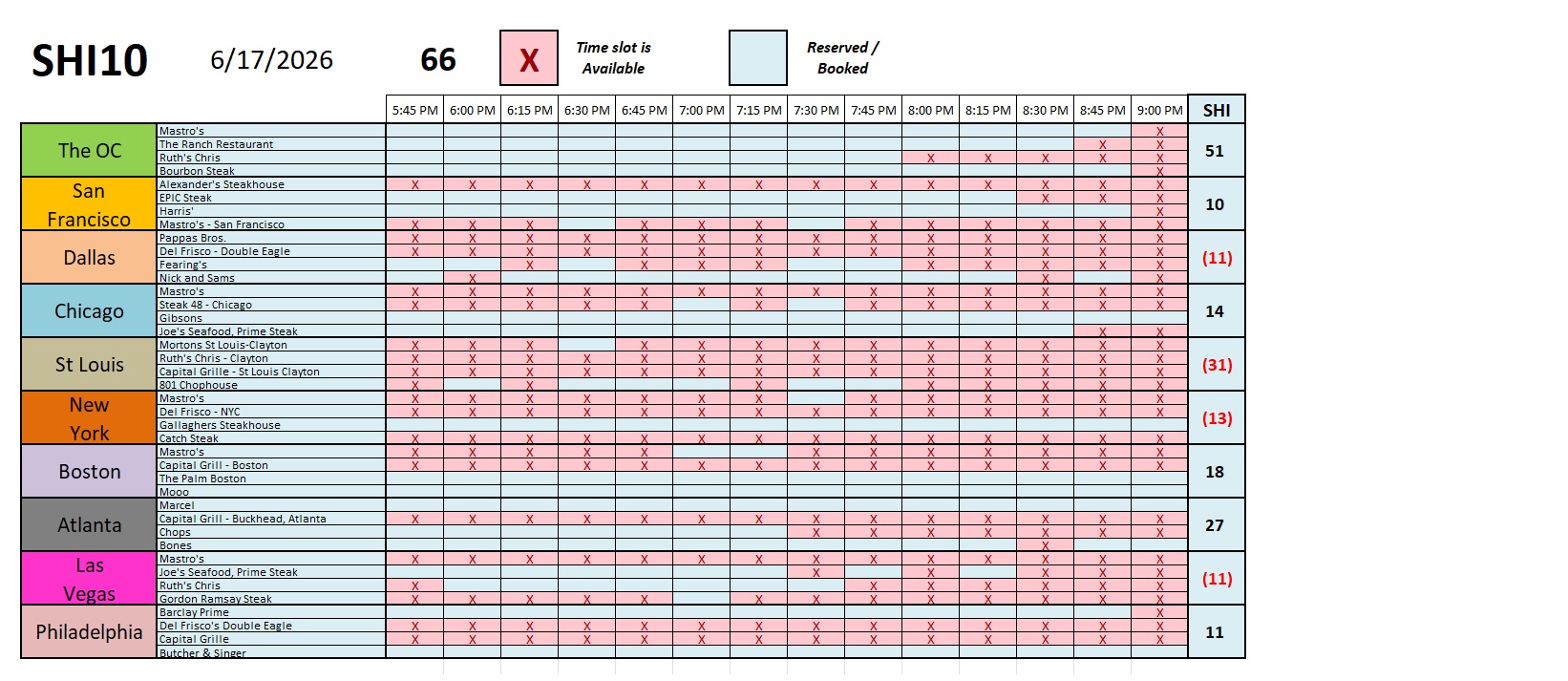
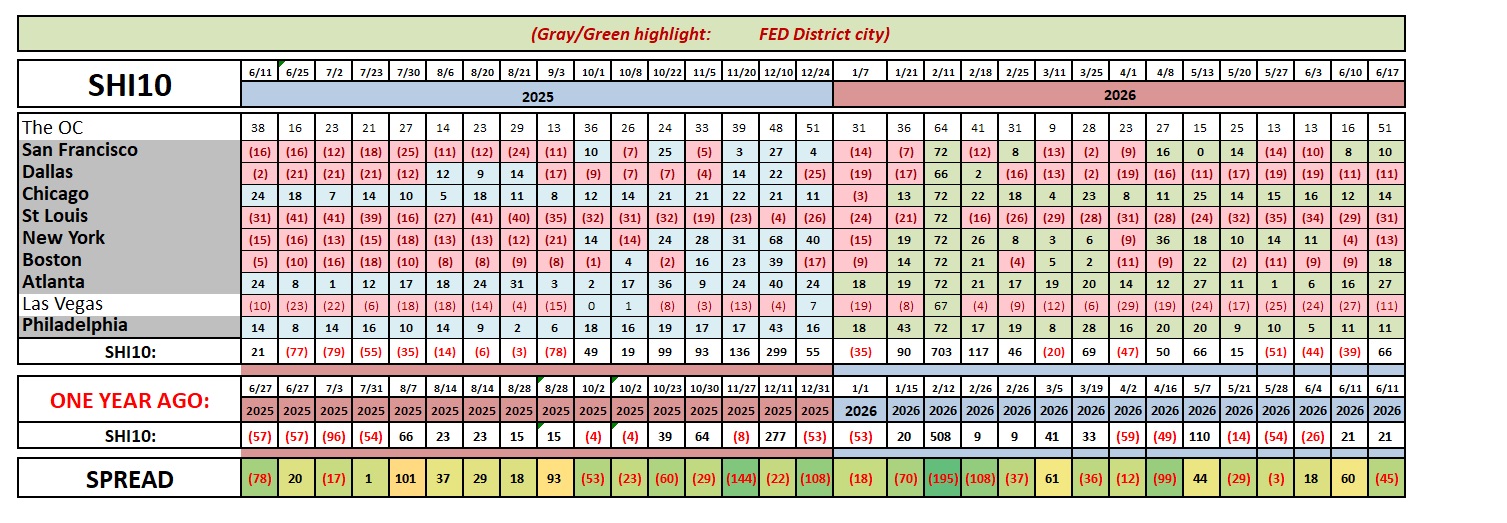
Today’s SHI10 metric of a positive 66 is strong — stronger than the prior 3 weekly numbers. Reservation in the OC is strong this weekend. Other markets around the US were more consistent with prior weeks. Here’s the longer term trend chart: